Four Stages, Three Walls: How GCCs Actually Mature

The most dangerous moment in the life of a Global Capability Center is not when it struggles. It’s when it succeeds at being efficient.

A center that hits its cost targets, clears its tickets, and keeps its attrition in check looks, by every dashboard available to leadership, like a triumph. And it is — at being a delivery engine. The trouble is that delivery excellence is precisely the thing that anchors a center in place. It performs so well at executing other people’s decisions that no one, least of all the parent organization, feels any urgency to let it make its own. The reward for running the process flawlessly is being asked to run more process.

This is the capability trap, and it is where the majority of GCCs quietly spend their entire existence. Not failing. Just plateaued, one stage short of the only thing that would make them genuinely hard to replace.

To see why, it helps to lay out the maturity curve a center can climb, and to be honest about how rarely the top of it is reached.

Four stages, and the walls between them

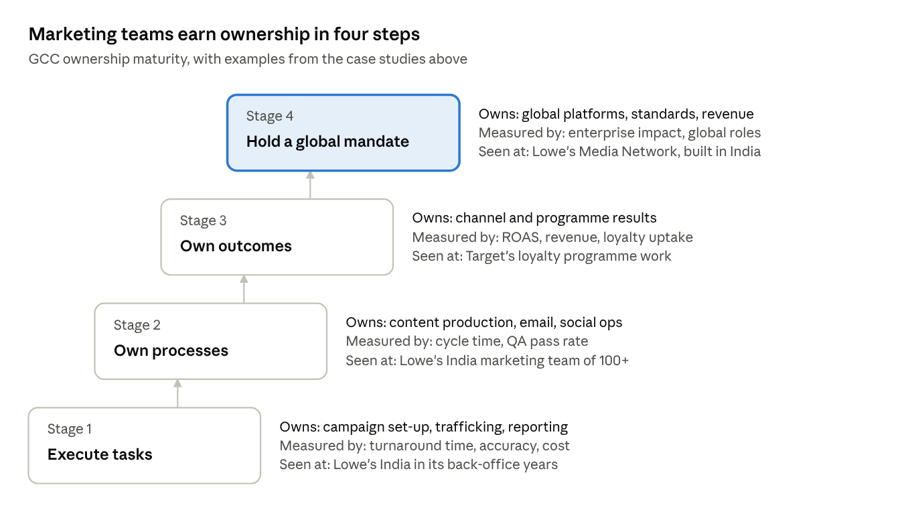
Stage one is the cost center. The mandate is to perform defined work reliably and cheaply. Metrics are inputs and unit costs. The center is an extension of a process designed elsewhere, and its virtue is fidelity. Most GCCs are born here, and there is nothing wrong with that — the problem is mistaking a starting line for a finish.

Stage two is the capability center. The work gets harder, so the center builds depth: specialized engineering, domain fluency, scarce skills. This is real and valuable, and it is where most centers top out. But note what hasn’t moved. The center is now excellent at solving problems it did not choose. Capability without authority is simply a more sophisticated form of delivery — the team can answer any question put to it, but it is never the one deciding which questions are worth asking.

Stage three is the value center. Here the measure changes from how well we executed to what changed in the business because we did. Output gives way to outcomes. And the relationship with headquarters quietly inverts: instead of receiving locked requirements, the center starts shaping them, because its proximity to the actual problem makes its judgment too useful to consult only after the fact.

Stage four is the ownership center. The people inside behave less like a remote team and more like business owners who happen to sit in a particular city. They hunt for problems rather than wait for them. They act on what they find. And the organization trusts that agency enough not to demand a mandate for every move. What separates this stage from the one below is not skill — the center has had skill since stage two. It is agency. The clearest signal a GCC has arrived: when its people see a problem, their first instinct is to solve it, not to escalate it.

The stages are easy to list. The walls between them are what most discussions skip.

The wall isn’t capability. It’s permission.

Here is the counterintuitive part. The barrier between stage two and stage three is almost never a skills gap. The people are good enough. The barrier is a permission gap — and permission is rationed by a force that rarely gets named: the cost of distance.

A center thousands of miles and several time zones from headquarters operates under a quiet tax. Every decision that has to travel up and back before it can be acted on accrues delay, dilution, and the slow erosion of initiative. Faced with that friction, two things happen. Headquarters learns to over-specify, parceling work into tasks precise enough to survive the distance. And the center learns to under-reach, because asking for context costs more than just doing the narrow thing in front of it. Each side adapts rationally, and the joint result is a center permanently optimized for execution and structurally discouraged from ownership.

This is why throwing resources at the problem rarely works. More headcount, bigger budgets, better tooling — these deepen capability, which the center already has. They do nothing about permission. A center can double in size and remain exactly as far from stage four as the day it was founded, because no one ever transferred the one thing that matters: the right to decide.

What ownership is actually downstream of

If permission is the constraint, the unlock is the democratization of the problem itself — and it is worth being precise about what that means, because it is easy to sentimentalize.

In a stage-one or stage-two center, the problem belongs to leadership or to an external vendor. It arrives pre-chopped into tasks, and the people doing the tasks rarely see the whole shape of what they’re contributing to. You cannot own a fragment. Ownership requires line of sight to the entire problem — the business goal behind the requirement, the customer behind the ticket, the why behind the what.

So democratizing the problem means three concrete transfers, none of them free:

  • Context — the people closest to the work can see the actual objective, not just their slice.
  • Standing — they are expected to form and voice a view, and that view carries weight.
  • Latitude — they can act inside a sensible boundary without seeking permission for each step.

Give people all three and ownership tends to appear almost on its own, because human beings reliably take responsibility for what they can see and shape, and stay passive toward what is handed to them in pieces. Withhold any of the three and no quantity of culture messaging will manufacture the feeling. You can tell people they are empowered, but if every real decision still has to travel upstream, they will correctly conclude that the words are decoration.

This reframes the whole maturity curve. It isn’t a ladder of growing capability — by stage two the capability is largely in place. It is a steady transfer of access:

  1. Cost center — the people execute the task.
  2. Capability center — the people master the craft.
  3. Value center — the people influence the goal.
  4. Ownership center — the people own the problem.

Every step up is leadership choosing to hand a little more of the real problem to the people nearest to it. The climb is less about what the center earns and more about what headquarters is willing to let go of.

The economics nobody puts on the slide

There is a hard business case underneath all of this, and it is not the obvious one.

The familiar GCC economics are subtractive — every function moved offshore saves a delta against onshore cost. That logic has a ceiling, and worse, a floor that keeps rising: as the talent market matures, the cost gap narrows, and a center justified purely by arbitrage watches its core rationale erode year over year. A pure cost center is a depreciating asset.

An ownership center runs on different math. Its value is not the cost it removes but the value it originates — the problem spotted before it became expensive, the build done in-house instead of contracted out, the product improvement that no one at headquarters had the proximity to notice. This value is additive and compounding, and crucially it is invisible on a cost dashboard. That invisibility is exactly why so many centers never get the permission to generate it: the instrument leadership uses to measure the center is incapable of detecting the thing that would make it indispensable. Centers managed by the cost dashboard are, in effect, being optimized away from their own highest potential.

The part that should make leaders uncomfortable

It would be dishonest to pretend ownership is free of risk. Handing real latitude to a distant team means accepting that some decisions will be made differently than headquarters would have made them, and occasionally made wrong. Agency without alignment is just chaos with good intentions.

So the fourth stage is not the absence of control — it is the substitution of one kind of control for another. The cost-center model controls through specification: tell people exactly what to do. The ownership model controls through alignment: make sure people deeply understand the goals, the guardrails, and the trade-offs, then trust them inside that frame. The first scales badly across distance and kills initiative. The second is harder to set up and demands more of leadership, but it is the only model that survives complexity, because no headquarters can pre-specify its way through problems it cannot see coming.

This is the real ask, and it is uncomfortable precisely because it lands on the parent organization rather than the center: reaching stage four requires leadership to give up the reassurance of specification in exchange for the harder discipline of alignment. Most don’t, and then wonder why their “strategic center” keeps behaving like a delivery shop.

The talent dimension that forces the issue

Even leaders unmoved by any of this are being pushed up the curve by the labor market, whether they like it or not.

The people capable of stage-four work — the ones who can see a problem whole and act on it — are precisely the people who will not stay to do stage-one work. Executor-grade mandates retain executor-grade talent. The senior engineer who built something real once will leave the moment the work narrows back into ticket-closing, and they will leave for an organization that hands them the whole problem. So a center that refuses to climb the curve doesn’t just cap its value; it slowly sheds exactly the people who could have raised it. The maturity question and the retention question turn out to be the same question wearing two hats.

How to find your real stage

Most organizations would place their own GCC a notch higher than it actually operates, because the stages are defined by behavior under pressure, not by ambition on a slide. The honest test is to watch the gaps — the moments no process anticipated.

When something breaks that nobody was assigned to fix, who moves first? When an opportunity appears that wasn’t in anyone’s objectives, does the center reach for it or route it upward? When there is no specification covering a situation, is that experienced as a blocker — or as room to act?

The answers locate a center far more truthfully than any framework, because the fourth stage was never about doing more work, or doing it cheaper, or even doing it better. It was about reaching the point where the people doing the work are trusted, and trust themselves, to decide what the work should be.

That is the version worth building toward. Not a center that executes flawlessly, but one that owns outcomes — because it was finally handed the whole problem, and chose to pick it up. The capability trap catches the centers that wait to be given that. The ones that escape it tend to stop waiting.

It’s the part of this work we find most worth doing at Versitae — sitting close enough to a center to understand where it actually is on the curve, and helping the climb to the next stage feel less like a leap and more like the next natural step.

The Future of GCCs Will Be Defined by Ownership

The GCC story in India has entered a new chapter. For years, Global Capability Centers were evaluated through a familiar lens: cost, scale, and delivery efficiency. That lens is no longer enough. India now hosts over 1,700 GCCs, employs more than 1.9 million people through them, and accounts for roughly 55% of the global GCC footprint. The market was valued at about $64 billion in FY2024 and is projected to reach $99 billion to $105 billion by 2030, with employment rising to 2.5 million to 2.8 million people.

That scale matters, but the more important shift is qualitative. GCCs are increasingly being asked to own outcomes, shape decisions, and build enterprise capability that endures. EYΓÇÖs 2025 pulse survey found that 92% of leaders see GCCs contributing far beyond cost arbitrage, while 58% are investing in agentic AI and 83% are investing in GenAI. Two-thirds are also creating dedicated innovation teams and incubation programs to generate and globalize ideas from India.

From capacity to capability

The future of GCCs will not be decided by how many people they hire. It will be decided by what they own. That is the central shift underway in the best centers today. The strongest GCCs are moving from being execution hubs to becoming platforms for product development, advanced analytics, AI, engineering, and decision support. In the EY survey, business intelligence adoption rose to 86%, data strategy to 67%, and GenAI is already being applied to customer service, finance, operations, and IT and cybersecurity.

This is what outcome-based GCC design looks like in practice. Instead of building around functions alone, enterprises are building around business problems: reducing stock-outs, improving personalization, accelerating product release cycles, modernizing risk controls, or improving forecast accuracy. The center becomes valuable when it changes what the enterprise can do, not just what it can process.

That is why ΓÇ£ownershipΓÇ¥ is becoming the most important design principle. A GCC that owns a dashboard is useful. A GCC that owns the forecasting logic behind a merchandising decision is strategic. The difference is subtle on paper and massive in reality.

IndiaΓÇÖs role is bigger than location

India is not just where GCCs are located. India is shaping how the model evolves. The ecosystem now includes deep engineering talent, mature IT services firms, cloud and SaaS providers, startup ecosystems, and city-level policy support. EY notes that by 2030 India could host 2,200 to 2,500 GCCs, and the market could reach about $110 billion.

That growth is also concentrating in specific geographies. ACCAΓÇÖs 2025 report notes that Karnataka alone houses about 875 of IndiaΓÇÖs 1,700 GCCs, with Bengaluru hosting 27% of all Indian GCCs and 37% of GCC talent. The same report points to state-level policy pushes in Karnataka, Uttar Pradesh, and Gujarat, showing that GCCs are now part of industrial policy, not just corporate strategy.

This matters because GCC growth is no longer a private enterprise phenomenon. It is a national development story. It shapes office markets, talent migration, salary inflation, local vendor networks, and the trajectory of cities. Colliers estimates GCCs could drive 40% to 50% of IndiaΓÇÖs office demand across the top seven cities, and says GCCs have already accounted for about 117 million square feet of office demand since 2020.

The IT ecosystem as a strategic asset

One of IndiaΓÇÖs biggest advantages is not just the talent pool. It is the surrounding ecosystem. Global firms can launch faster in India because they are not building from zero. They are plugging into a dense web of implementation partners, infrastructure providers, cloud specialists, cybersecurity firms, SaaS vendors, and service integrators. That ecosystem makes India a practical place to test, industrialize, and scale capability.

This is also why the future GCC will likely be more partner-led than before. The best centers will use local vendors and platforms not simply to reduce cost, but to accelerate experimentation, harden technology stacks, and co-create IP with better speed and discipline. That dynamic is already visible in the kinds of mandates flowing into India: advanced analytics, AI-native engineering, cloud computing, and product development. Colliers expects GCCs in India to become increasingly integral to research, product development, engineering, advanced analytics, AI, machine learning, and cloud computing.

At the same time, this ecosystem creates a responsibility. If enterprises use India only as a delivery base, they will underuse its strategic value. If they use it as an innovation and outcome engine, the model becomes much more durable. The real advantage is not low cost. It is compound capability.

The future GCC will be AI-native and decision-led

The next phase of GCCs will be shaped by AI not as a tool, but as an operating assumption. EYΓÇÖs survey shows 58% of India GCCs are already investing in agentic AI, 83% are investing in GenAI, and 81% are upskilling internal teams on GenAI. That means the future GCC is being designed with AI in mind from the start, not retrofitted later.

This is a profound change. The future center will not just manage a process faster. It will increasingly make better decisions at scale. It will sense demand, optimize pricing, automate support, govern risk, and surface recommendations that influence leaders across markets. It will also need stronger governance, because the more a center owns, the more the enterprise must trust it.

That trust will depend on whether the GCC can prove three things: quality, speed, and judgment. AI can help with the first two. The third depends on people, leadership, and operating discipline.

What will define the winners

The GCCs that win in the future will have a few things in common.

They will own outcomes, not just tasks.
They will keep moving up the value chain as work gets commoditized.
They will integrate with global teams as one enterprise system, not as a remote execution layer.
They will invest in leadership depth, not just headcount.
And they will build strong partnerships across IndiaΓÇÖs IT ecosystem without losing sight of IP, governance, and resilience.

That last point matters more than ever. The future will belong to organizations that can move quickly while still protecting intellectual property, operational continuity, and decision quality. IndiaΓÇÖs ecosystem makes that possible, but only if enterprises design for it deliberately.

The road ahead

The future of GCCs in India is neither a simple success story nor a risk story. It is a transformation story. GCCs are becoming a major mechanism through which global enterprises distribute capability, and India is becoming the place where a large share of that capability is built. The scale is real, the AI momentum is real, and the real estate and policy signals all point in the same direction.

The question now is not whether GCCs will grow. They will. The question is what they will become. Will they remain efficient delivery systems, or will they become outcome-led centers that shape enterprise strategy? Will India remain a location advantage, or become a capability advantage? The answer depends on how deliberately enterprises design the next phase.

The most successful GCCs ahead will not simply be larger. They will be more trusted, more strategic, more AI-native, and more tightly aligned to business outcomes. That is where the future is heading.

The Maturity Curve of GCCs: Getting Beyond the Setup Story

Global Capability Centers (GCCs) have moved well beyond their early identity as cost-arbitrage engines. In India especially, the ecosystem has matured into a sophisticated network of technology, analytics, product, and operational hubs that support global enterprises at scale.

Yet maturity in the ecosystem does not automatically translate to maturity within each GCC.

Some centers evolve into strategic capability anchors. Others plateau at execution scale. The difference rarely lies in talent quality alone. It lies in clarity of mandate, leadership design, operating structure, and long-term intent.

Having observed multiple GCC journeys across industries, here is a grounded view of how maturity develops, where organizations go wrong, and how to set up for sustained success.


Understanding GCC Maturity

A mature GCC is not defined by headcount or years in operation. It is defined by three characteristics:

  1. Ownership of outcomes, not just tasks

  2. Embedded influence in enterprise decision-making

  3. Repeatable, scalable operating models

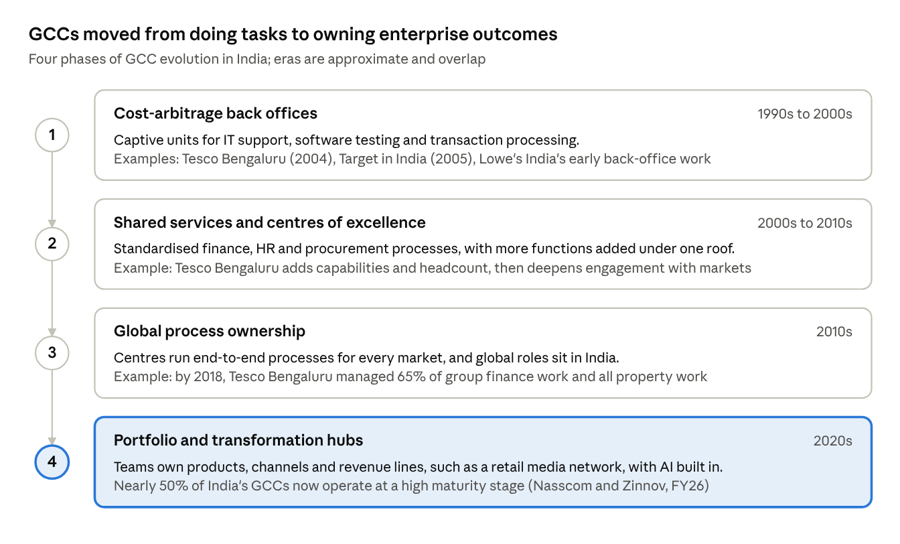
Most GCCs move through four broad stages:

1. Execution Hub

The early phase focuses on delivery efficiency. Processes are documented, SLAs are defined, and cost optimization is central. This phase is necessary, but insufficient for long-term relevance.

2. Capability Builder

The center begins developing domain depth. Teams expand beyond transactional work into analytics, engineering, product support, or transformation programs. Leadership starts investing in stronger governance and talent models.

3. Strategic Partner

The GCC earns trust from global stakeholders. It contributes to roadmaps, owns platforms, and participates in enterprise-level planning conversations.

4. Innovation Anchor

The most mature centers lead experimentation, incubate new capabilities, and influence enterprise strategy. They become a source of competitive differentiation.

The transition between these stages is where most complexity lies.


Common Pitfalls in GCC Evolution

Even well-funded GCCs encounter structural friction. The most common pitfalls include:

1. Scaling Headcount Without Scaling Mandate

Growth in size is often mistaken for growth in maturity. Rapid hiring without expanding scope or ownership leads to operational bloat and unclear accountability.

2. Ambiguous Governance

Unclear reporting lines between headquarters and GCC leadership create tension. Without defined decision rights, teams oscillate between autonomy and over-control.

3. Treating the GCC as a Vendor

When headquarters interacts with its own GCC through transactional SLAs rather than strategic dialogue, the center struggles to move up the value chain.

4. Underinvesting in Leadership

Technical talent is abundant in IndiaΓÇÖs ecosystem. Mature GCCs differentiate themselves through strong local leadership capable of influencing global stakeholders, not just managing delivery.

5. Ignoring Cultural Integration

Capability maturity requires trust. If global teams view the GCC as peripheral, influence remains limited regardless of technical competence.


Setting Up a GCC the Right Way

A successful GCC setup is less about real estate and hiring plans and more about strategic design.

1. Define the Mandate Clearly

Before the first hire, leadership must answer:

  • Is this center focused on efficiency, capability, innovation, or all three?

  • What decisions will eventually be influenced from this location?

  • How will success be measured beyond cost savings?

Mandate clarity prevents structural confusion later.

2. Start with Focused Capability, Not Broad Scope

Centres that begin with a clear capability charter ΓÇö data engineering, cloud platforms, product engineering, finance transformation ΓÇö build credibility faster than those attempting to serve every function at once.

Focused ownership creates depth. Depth creates trust. Trust enables scale.

3. Invest Early in Governance

Define operating rhythms between HQ and GCC leadership from the beginning:

  • Roadmap alignment cycles

  • Funding approval processes

  • Escalation protocols

  • Talent development pathways

Governance maturity reduces friction as the center grows.

4. Build Leadership That Can Influence, Not Just Deliver

A GCC head must function as a business leader, not merely an operations manager. They need credibility with global executives and the ability to articulate business value, not just execution metrics.

5. Design Career Pathways Intentionally

Retention becomes critical once capability depth is established. Mature GCCs provide:

  • Technical specialization tracks

  • Leadership tracks

  • Cross-functional mobility

  • Exposure to global assignments

Talent strategy is inseparable from capability maturity.


The Shift from Cost to Capability

One of the clearest signs of GCC maturity is how performance conversations evolve.

Early-stage discussions revolve around:

  • Cost per FTE

  • SLA compliance

  • Utilization metrics

Mature-stage discussions focus on:

  • Product velocity

  • Innovation pipeline

  • Business impact metrics

  • IP creation

  • Enterprise risk resilience

When conversations shift from efficiency to influence, maturity has begun.


What the Next Phase of GCC Maturity Looks Like

Across industries, several patterns are emerging:

  • Data and AI mandates are increasingly anchored within GCCs.

  • Product ownership is shifting offshore, not just product support.

  • GCCs are becoming testbeds for enterprise transformation initiatives.

  • Mid-market enterprises are adopting more focused, capability-led setups rather than large-scale launches.

Maturity today is less about size and more about integration into enterprise strategy.


Final Perspective

Setting up a GCC is straightforward. Maturing it is not.

The difference between a large center and a strategic one lies in clarity of intent, disciplined governance, leadership depth, and a long-term view of capability building.

IndiaΓÇÖs ecosystem offers extraordinary talent and infrastructure advantages. But those advantages translate into enterprise value only when design choices are deliberate.

For organizations entering or expanding the GCC journey, the central question should not be: ΓÇ£How fast can we scale?ΓÇ¥

It should be:

ΓÇ£How intentionally are we building capability that the enterprise cannot operate without?ΓÇ¥

That is the real marker of maturity.

From Pod to GCC: How Retailers Are Choosing to Scale Capability Differently


Retailers are no strangers to operating at scale. Yet when it comes to building Global Capability Centers (GCCs), many are rethinking the traditional ΓÇ£build big from day oneΓÇ¥ approach. Instead, a growing number are starting smaller ΓÇö with focused analytics or AI pods ΓÇö proving value in specific retail problems, and then expanding those pods into full GCCs.

This pod-to-GCC approach is emerging not as a compromise, but as a deliberate strategy. It reflects how modern retail organizations want to learn, invest, and scale: grounded in outcomes, shaped by business realities, and aligned with how decisions are actually made on the ground.


Why retail organizations are starting with pods

Retail complexity doesnΓÇÖt come from lack of ideas ΓÇö it comes from competing priorities. Merchandising, supply chain, pricing, digital, and store operations all want analytics and AI support, often at the same time. Pods help leaders impose focus.

1. Pods anchor capability to a real retail decision
Rather than building a broad analytics function upfront, retailers are launching pods around one decision that matters:

  • Improving demand forecasting accuracy for a high-variance category
  • Reducing markdown exposure in seasonal merchandise
  • Personalizing promotions for a specific customer segment
  • Optimizing replenishment for a subset of stores or regions

Because the pod is tied to a single decision owner ΓÇö a merchandising head, supply chain leader, or digital VP ΓÇö it stays grounded in business impact rather than abstract models.

2. They create credibility with business teams
In retail, trust is earned through results. A small pod that improves forecast accuracy or reduces stock-outs in one category does more to build confidence than a large central team that takes months to show value.

Once merchants and operators see analytics influencing outcomes they care about ΓÇö margin, availability, sell-through ΓÇö demand for the capability grows organically.


What a retail pod actually looks like in practice

A retail pod is not a lab. It is a delivery unit.

Typical pods combine:

  • Data engineering (POS, inventory, supply chain, digital signals)
  • Analytics or data science (forecasting, optimization, segmentation)
  • A product or business translator who speaks merchant language
  • Close, continuous interaction with the business team using the output

For example:

  • A pricing pod may work directly with category managers, testing elasticity models alongside promotional calendars.
  • A supply chain pod may partner with planners to embed forecasts into existing replenishment workflows, not replace them.
  • A personalization pod may start with one channel (email or app) before expanding across touchpoints.

The goal is not sophistication ΓÇö it is adoption.


How pods evolve into a GCC

As pods succeed, something important happens: patterns emerge.

Retailers begin to see repeatable elements across use cases:

  • Common data pipelines (POS, inventory, customer, vendor data)
  • Reusable features (seasonality curves, substitution logic, customer segments)
  • Standard deployment and monitoring practices
  • Shared governance for data quality and model ownership

At this point, scaling makes sense ΓÇö not as headcount growth alone, but as capability consolidation.

When a GCC emerges from pods, it typically:

  • Retains a core CoE that continues to incubate new retail use cases
  • Scales delivery teams that industrialize proven solutions
  • Serves multiple functions using shared platforms and standards
  • Owns long-term capability rather than one-off projects

In retail terms, this is the difference between building a tool for one category and building a capability that supports many.


What retailers get right ΓÇö and wrong ΓÇö when scaling

What works well

  • Expanding into adjacent retail problems once the first pod proves value
  • Reusing assets across categories instead of rebuilding models each time
  • Rotating talent between pods and scaled teams to avoid silos
  • Keeping merchants and operators involved even as scale increases

Common missteps

  • Scaling talent faster than demand from the business
  • Treating the GCC as a reporting factory instead of a decision partner
  • Losing proximity to the business as teams grow
  • Underinvesting in career paths, leading to attrition of strong talent

Retail GCCs that succeed tend to protect what made the pod effective: clarity of purpose, business intimacy, and ownership of outcomes.


Measuring success beyond cost

Retail leaders increasingly evaluate GCCs on questions such as:

  • Are category teams making better decisions with this capability?
  • Are forecasts and recommendations actually used in planning cycles?
  • Is time-to-insight improving for merchants and operators?
  • Are solutions reused across banners, regions, or channels?

Cost efficiency matters ΓÇö but in retail, value is proven when analytics changes how the business runs.


Why this approach resonates now

Retail is evolving quickly: omnichannel complexity, shorter product lifecycles, tighter margins, and rising customer expectations. Leaders want flexibility without losing control.

The pod-to-GCC approach offers that balance:

  • Start where value is clear
  • Learn in the context of real retail decisions
  • Scale only what works
  • Build long-term capability without overcommitting upfront

ItΓÇÖs not a replacement for traditional GCC models ΓÇö itΓÇÖs an alternate path that reflects how many retail organizations prefer to move today.

At Versitae, we work with retailers to design GCC journeys that respect the realities of retail ΓÇö balancing speed with discipline, experimentation with scale, and innovation with execution.

Working in a GCC: Why the Career Experience Is Fundamentally Different


For many professionals in India, Global Capability Centers (GCCs) are no longer just another place to work ΓÇö they represent a distinct career experience.

While GCCs were once viewed primarily as offshore delivery arms, today they are becoming environments where people build deep expertise, long-term careers, and global influence. The difference isnΓÇÖt just in the work itself ΓÇö itΓÇÖs in the culture, ownership, and career pathways that GCCs enable.

As GCCs evolve, so does what it means to work in one.


From Projects to Ownership

One of the biggest differences employees notice when moving into a GCC is the shift from project-based execution to product and capability ownership.

In many traditional services or outsourcing environments, work is scoped tightly around client projects. Teams rotate frequently, priorities shift quickly, and success is often measured by delivery speed alone.

In contrast, GCC teams typically:

  • Own platforms, data products, or business capabilities end-to-end
  • Stay with the same domain or product for longer periods
  • See the downstream impact of their work on real business outcomes

This sense of ownership changes how people engage with their work. Engineers, analysts, and product managers arenΓÇÖt just delivering tasks ΓÇö theyΓÇÖre shaping systems that evolve over time. That continuity often leads to stronger technical depth and higher engagement.


A Different Kind of Culture

Culturally, GCCs tend to operate closer to their parent organizationΓÇÖs values and ways of working. This shows up in subtle but meaningful ways.

Decision-making is often more collaborative. Teams have greater visibility into why something is being built, not just what needs to be delivered. There is also typically more emphasis on quality, sustainability, and long-term thinking ΓÇö because the work is owned, not handed off.

Employees often describe GCC environments as:

  • Less transactional, more relationship-driven
  • More open to questioning and problem-solving
  • Aligned to enterprise goals rather than short-term milestones

This doesnΓÇÖt mean GCCs are slower or easier ΓÇö but the pressure is different. The expectation is not just execution, but thoughtful contribution.


Career Paths That Go Beyond Titles

One of the most compelling aspects of working in a GCC is the breadth of career paths available.

Because GCCs support global businesses, employees are exposed to multiple dimensions of growth:

  • Depth: becoming a subject-matter expert in data, AI, retail operations, platforms, or engineering
  • Breadth: moving across functions such as analytics, product, operations, and strategy
  • Leadership: growing into roles that manage global teams or enterprise-wide programs

Unlike linear career ladders, many GCCs offer career lattices ΓÇö allowing people to move sideways, deepen expertise, or step into leadership without having to leave the organization.

In mature GCCs, itΓÇÖs increasingly common to see India-based leaders owning global charters, influencing roadmap decisions, or acting as strategic partners to headquarters teams.


Learning ThatΓÇÖs Embedded, Not Bolted On

Another differentiator is how learning happens inside GCCs.

Rather than relying only on formal training programs, learning is often embedded into the work itself:

  • Exposure to global stakeholders and real business problems
  • Hands-on work with modern data stacks, cloud platforms, and AI tools
  • Opportunities to experiment, iterate, and improve over time

Many GCCs also invest heavily in internal academies, mentoring programs, and rotational roles ΓÇö not just to upskill employees, but to future-proof capability.

For employees, this creates an environment where learning feels relevant and continuous, rather than episodic.


Stability Without Stagnation

A common misconception is that stability and growth are mutually exclusive. GCCs often challenge this assumption.

Because GCCs are embedded within long-term enterprise strategies, they tend to offer greater stability compared to project-driven models. At the same time, the work itself continues to evolve ΓÇö especially as organizations invest more in data, AI, and digital transformation.

This balance appeals to professionals who want:

  • Predictability in their career trajectory
  • Meaningful work that evolves with technology and business needs
  • The ability to grow without constantly switching employers

For many, GCCs offer a middle ground between the volatility of fast-moving startups and the rigidity of traditional enterprises.


A Sense of Belonging to Something Larger

Perhaps the most understated difference is the sense of belonging.

Employees in GCCs often feel more closely connected to the enterprise mission. They interact directly with global teams, see how their work fits into the bigger picture, and understand the business context behind decisions.

This connection fosters pride ΓÇö not just in the work produced, but in being part of a global organization where contributions are visible and valued.

Over time, this sense of belonging becomes a powerful retention lever ΓÇö one that salary alone cannot replicate.


What This Means for the Future of Work in GCCs

As GCCs continue to mature, the employee experience will become an even stronger differentiator.

Organizations that succeed will be those that:

  • Treat talent as a long-term investment, not a scalable resource
  • Design roles around ownership, learning, and impact
  • Build cultures that balance global standards with local context

For professionals, GCCs are increasingly places where careers are built, not just progressed.

And for the ecosystem as a whole, this shift signals something important: GCCs are no longer just changing how work gets done ΓÇö theyΓÇÖre changing how people experience work.


Mid-Market GCCs in India: From Talent Pools to Strategic Engines

Global Capability Centers (GCCs) have evolved dramatically over the past decade and nowhere is this more visible than in India. Once seen primarily as cost-efficient delivery hubs, todayΓÇÖs GCCs are centres of innovation, data and analytics excellence, and operational resilience. Mid-market enterprises, those typically between $200 million and $1 billion in annual revenue are increasingly embracing IndiaΓÇÖs GCC model to build capability with precision, purpose, and measurable impact.

IndiaΓÇÖs GCC ecosystem has matured into a global powerhouse. As of 2024ΓÇô25, the country hosts 1,700 + GCCs, making it the largest GCC hub in the world with nearly 55 % of global share in both centre count and revenue contribution.

Within this broader trend, mid-market GCCs are emerging as a distinct strategic segment enabling businesses to be resilient, innovative, and future-ready.


1) Mid-Market GCC Growth ΓÇô Job Creation, Scale & Strategic Value

One of the most talked-about figures in this space is the employment and expansion potential tied to mid-market GCC growth in India.

According to a recent industry survey, mid-market GCCs are projected to create around 40,000 new jobs by the end of 2026, bringing total mid-market GCC employment to over 260,000 professionals. This isnΓÇÖt just about numbers ΓÇö it reflects how mid-market firms are embedding critical capability ΓÇö from data engineering and analytics to cloud operations and AI experimentation ΓÇö inside IndiaΓÇÖs high-growth talent ecosystem.

Importantly, this growth isnΓÇÖt concentrated only in metro cities. While Bengaluru, Hyderabad and Pune continue to be major hubs, thereΓÇÖs a widening distribution into tier-2 and tier-3 cities as well, reflecting broader opportunities and reducing regional imbalance.


2) From Cost Arbitrage to Capability Engines

Historically, GCCs were established in offshore locations largely for cost advantages ΓÇö reducing operational expense compared to headquarters markets. That trend continues: mid-market GCCs often realise 30ΓÇô40 % cost savings versus other global locations, enabling reinvestment into technology and innovation.

But todayΓÇÖs GCCs are far more than cost centres. IndiaΓÇÖs talent depth, especially in engineering, cloud computing, analytics, and AI, is turning these centres into capability engines. Recent trends indicate:

  • Over 50 % of IndiaΓÇÖs GCCs are managing end-to-end product, platform, or analytics mandates, rather than only transactional or support tasks.

  • Nearly 50 % of GCC leaders plan to prioritise AI as a core function over the next few years.

This evolution is particularly relevant for mid-market retailers. These firms often lack in-house depth in areas like predictive analytics, customer intelligence, supply chain optimisation, and personalization engines. By setting up GCCs with a core strength in data and AI analytics pods, they unlock pathways to differentiated retail execution ΓÇö from real-time pricing recommendations to demand forecasting and churn prediction.


3) How Mid-Market GCCs are Structured for Impact

The way mid-market GCCs are designed and scaled shows a deliberate shift toward value-led prioritisation. Instead of large, unfocused hubs that try to do everything at once, successful mid-market firms follow a more disciplined journey:

A. Start with Targeted Pods

Leading GCCs begin with small, focused units around high-impact areas:

  • Analytics and data engineering pods that build foundational data platforms.

  • AI and ML squads focused on personalization, forecasting, or automation.

  • DevOps and cloud centres that enable scalable deployments.

These pods operate like mini-CoEs ΓÇö with clear KPIs, short feedback loops, and cross-functional mandates. Once they deliver measurable results ΓÇö say, a 10 % uplift in forecast accuracy or a 5 % inventory cost reduction ΓÇö they become the blueprint for broader GCC capability.

B. Codify and Institutionalise

Once early wins are secured, teams focus on codifying patterns and standards ΓÇö from model governance and data contracts to reusable components. This phase often involves documenting workflows, establishing SLAs with stakeholders, and defining talent pathways.

C. Scale with Confidence

With a track record of outcomes and institutional rigour, these pods then evolve into larger GCCs ΓÇö integrating more use cases, building global automation platforms, and driving continuous improvement.

This staged approach helps mid-market enterprises manage risk, control costs, and maintain focus on business outcomes instead of organizational complexity.


4) Strategic Roles Beyond Delivery

A defining feature of modern mid-market GCCs is their role in strategic decision-making. GCCs are increasingly contributing to:

  • Global product roadmaps by owning analytics that drive CX improvements.

  • Automated business workflows that augment core operational processes.

  • Innovation pipelines for next-generation digital products.

  • Cross-regional insights that shape leadership decisions across markets.

This shift turns GCCs into global accelerators, not just execution engines. For example, analytics led from GCCs can directly inform marketing personalization strategies or post-purchase operations ΓÇö outcomes that directly impact revenue rather than merely reduce costs.


5) Broader Ecosystem Impact

IndiaΓÇÖs GCC boom is not limited to tech or BFSI. Retail, manufacturing, life sciences, and energy sectors are all building GCC capabilities, often blending local insights with global strategy. The presence of 1,800 + centres ΓÇö with projections to reach over 2,400 by 2030 ΓÇö highlights both the scale and diversity of the ecosystem.

The broader macro impact is significant:

  • GCCs contribute a meaningful share of IndiaΓÇÖs GDP and services export growth, underlining their economic relevance.

  • They attract global firms ΓÇö including new interest from FMCG majors and data-driven enterprises ΓÇö who view India as a location not just for delivery but for innovation and R&D.

  • The emergence of GCC roles has raised career expectations and compensation benchmarks, benefiting talent at all levels.


Conclusion: A Strategic Playbook for Mid-Market Growth

Mid-market GCCs in India are more than operational hubs ΓÇö they are strategic engines that help firms compete at scale. By starting with focused analytics and AI capability, codifying results quickly, and scaling with a disciplined framework, these centres help mid-market firms harness global talent, accelerate digital outcomes, and drive measurable business value.

For organisations exploring or expanding their GCC footprint, the journey is clear: prove early, scale thoughtfully, and embed capability at the core of business strategy. IndiaΓÇÖs GCC ecosystem, with its depth of talent and supportive policies, remains a compelling choice for this transition.

From Pod to GCC: A Smarter Path to Building Scalable Capability

Global Capability Centers (GCCs) have become the backbone of transformation ΓÇö powering data, digital, and AI-led innovation across industries. But not every organization needs to start with a large-scale setup from day one.

An alternate approach thatΓÇÖs gaining traction is the pod-to-GCC model ΓÇö beginning with a focused Center of Excellence (CoE) or pod, proving measurable value, and then scaling that foundation into a full-fledged GCC.

At Versitae, we see this as a practical, low-risk, and high-impact way to build long-term capability ΓÇö combining agility with structure, and innovation with control.


Why Start Small?

A pod-based start isnΓÇÖt about playing it safe ΓÇö itΓÇÖs about being intentional.

  1. Validate before scaling
    A focused pod (3ΓÇô6 months) allows you to prove one high-value use case ΓÇö in analytics, automation, or digital operations ΓÇö before committing larger investments.

  2. Build structure from the start
    Pods help establish early standards ΓÇö reusable data models, governance templates, and playbooks ΓÇö which form the backbone of your future GCC.

  3. Link growth to outcomes
    The model allows you to expand only when results are proven, keeping investment aligned with tangible ROI.


The Pod-to-GCC Journey

Phase 1: Launch a focused CoE or pod
Start small, with one strategic use case and a cross-functional team (around 10ΓÇô25 people).
Define clear KPIs such as time-to-market, efficiency gain, or business impact.

Phase 2: Codify what works
Turn learnings into reusable playbooks, define IP and governance norms, and capture knowledge that can be scaled across functions.

Phase 3: Scale into a GCC
Once the model is proven, expand in phases ΓÇö adding new use cases, business units, and teams.
Maintain balance between innovation (through the CoE) and scaled delivery (through the GCC).


What Makes It Work

  • Strong leadership alignment ΓÇö ensuring both global and local teams are bought in.

  • Clear governance and KPIs ΓÇö for intake, funding, and performance tracking.

  • Talent continuity ΓÇö rotating people between pod, GCC, and business teams.

  • Defined handoffs ΓÇö from experimentation to production, avoiding silos.


Why This Model Works Now

The pace of change in technology and talent markets means agility is as important as scale.
Starting with a pod helps organizations:

  • Build confidence with quick wins.

  • Reduce risk while testing new models.

  • Create a scalable foundation for the long term.

This isnΓÇÖt a replacement for traditional GCC models ΓÇö itΓÇÖs an alternate path for those who want to scale smarter, not faster.

At Versitae, we help enterprises design and operationalize this journey ΓÇö from the first pod to a globally scalable GCC ΓÇö ensuring every phase is linked to measurable value.

Unlocking the Next Frontier of Excellence: How Global Capability Centers (GCCs) are Driving Transformation

Global Capability Centers (GCCs) are playing a pivotal role in shaping the future of global enterprises, particularly in India, where they are well-positioned to spearhead transformation across industries. By embracing innovative approaches in products, processes, and leadership roles, these Centers are going beyond mere cost optimization to deliver substantial business impact.


Adapting to a New Era of Global Leadership


In recent years, GCCs have navigated through significant changes, particularly in the wake of the pandemic. This period saw an increased reliance on the GCC model, with organizations expanding their scope beyond traditional roles and accelerating the adoption of digital technologies. However, the path forward is fraught with challenges, including the need to attract niche talent, integrate emerging technologies, meet growing consumer expectations, harness the power of analytics, and adapt to rapidly changing business models. GCCs must continuously evolve their strategies to remain competitive.


Four Strategic Imperatives for GCC Success


To thrive in this dynamic environment, GCCs must focus on the following four critical areas:


 1. Building a Resilient Talent Strategy for Sustainable Growth


The global talent landscape is undergoing significant shifts, with a persistent imbalance in demand and supply. To tackle this, GCCs must proactively address talent challenges by enhancing their brand perception, employing innovative talent acquisition strategies, and cultivating a culture of continuous learning and development. Initiatives such as diversifying hiring practices, collaborating with external ecosystems, developing contingent workforce plans, and promoting diversity, equity, and inclusion will be crucial.


 2. Rethinking the Future of Work Beyond Remote Work Models


The future of work is not limited to remote or hybrid models; it encompasses a comprehensive approach that integrates the three core elements: Worker (talent strategy and sourcing models), Workplace (location strategy and hybrid working models), and Workways (technology integration and operational frameworks). A principle-driven approach that considers these factors holistically will be essential for GCCs to adapt and grow in the coming years.


 3. Expanding Beyond Traditional Domains through Cross-Functional Expertise


While IT and digital services remain central to GCC operations, there is a significant opportunity to diversify into non-traditional areas such as marketing and consulting. By leveraging cross-functional skills, GCCs can provide greater value, such as improved customer targeting or offering internal advisory services. This includes thought leadership in areas like Intelligent Automation and data analytics, enabling GCCs to play a more strategic role within their organizations.


 4. Redefining Location and Talent Strategies with a Focus on Sustainability and Inclusivity


GCCs must move beyond the conventional “cheap and large” approach to talent and location strategies. Incorporating Environmental, Social, and Governance (ESG) goals, including sustainability and diversity, will be vital. With climate change impacting service delivery, GCCs need to consider these factors when defining their long-term strategies, ensuring they remain resilient and inclusive.


Elevating the Role of IndiaΓÇÖs GCCs on the Global Stage

The evolution of India’s GCCs over the past decade has positioned them uniquely to integrate more deeply within their parent organizations, transcend geographic boundaries, and expand their impact on revenue growth. As they continue to innovate and lead, these Centers are poised to reach new heights, driving strategic transformation across global enterprises.

To learn more about how your company can leverage global talent hotspots and recession-proof your business through GCC setup, reach out to us.


 The Rise of Global Capability Centers (GCCs) in India: A Strategic Business Decision

Over the past few decades, India has emerged as a leading hub for Global Capability Centers (GCCs), becoming a vital component in the global strategy of many multinational corporations (MNCs). As companies worldwide seek to optimize their operations, drive innovation, and maintain resilience against economic downturns, the establishment of GCCs in India has proven to be a strategic move. This blog post explores the evolution of GCCs in India, the factors driving their growth, and why setting up a GCC in India is a compelling option for businesses looking to expand their global footprint.


 The Genesis of GCCs in India


The establishment of GCCs in India can be traced back to 1985 when Texas Instruments set up the first such center in the country. This move sparked a trend that saw many global giants, such as IBM and Accenture, follow suit. At the heart of this trend was India’s unique combination of abundant talent and cost-effectiveness, which made it an attractive destination for multinational corporations seeking to optimize costs while maintaining high standards of quality and innovation.


Initially, GCCs in India were primarily focused on providing back-office support and handling routine tasks. However, over time, their role has evolved significantly. Today, these centers are not just supporting global operations but are at the forefront of driving innovation, enhancing customer experience, and leading global digital transformations. India now boasts over 1,600 GCCs, collectively valued at over USD 46 billion. (Source: Nasscom GCC Report)

 Factors Driving the Growth of GCCs in India


Several factors have contributed to the rapid growth and success of GCCs in India:


  1. Academic Strength and Talent Availability:

– India produces approximately 2.3 million STEM graduates annually, creating a vast talent pool that is crucial for companies seeking specialized skills. This abundant supply of skilled professionals is a significant draw for global organizations looking to set up GCCs that focus on research, development, and innovation.


  1. Mature GCC Ecosystem:

– Over the years, India has developed a mature GCC ecosystem, characterized by streamlined processes, robust infrastructure, and a strong support network of service providers and partners. This maturity fosters an environment conducive to innovation and operational excellence, allowing companies to scale their operations efficiently.


  1. Government Support:

– The Indian government has played a pivotal role in promoting the establishment of GCCs by implementing favorable policies and initiatives that enhance the ease of doing business. This government support has not only attracted new investments but also built trust and confidence among multinational corporations, encouraging them to expand their operations in India.


  1. Cost-Effectiveness and Low Risk:

– The relatively low cost of experimentation in India makes it an attractive destination for companies looking to test new ideas, develop new products, or explore new markets. The risk associated with setting up and operating GCCs in India is considerably lower than in many other regions, further reinforcing the country’s appeal as a global GCC hub.


  1. Success Stories and Growing Confidence:

– The success of existing GCCs in India serves as a powerful testament to the country’s potential as a global capability center hub. Companies that have already set up GCCs in India have achieved significant cost savings, operational efficiencies, and innovation breakthroughs, encouraging more multinationals to invest in the region.


 Versitae and Systems Plus: Pioneering GCC Success


Versitae and Systems Plus have been at the forefront of helping global companies set up and manage GCCs in India. Over the years, these two firms have assisted in establishing more than 20 GCCs, primarily for global retail giants and organizations like Bright Horizons. These partnerships have been instrumental in driving operational efficiencies, fostering innovation, and enhancing customer experiences tailored to the unique needs of each client.


The success of these GCCs is not just about cost savings; itΓÇÖs about building resilient and scalable operations that thrive even in the face of economic challenges. By partnering with Versitae and Systems Plus, companies have been able to leverage deep expertise and experience in setting up and managing GCCs, ensuring they maximize the benefits of this strategic approach to global operations.


┬áIndia’s Evolution as a Global GCC Hub


IndiaΓÇÖs journey from being an underestimated economy to a global GCC powerhouse is a testament to the country’s evolving landscape of talent, innovation, and strategic importance. The countryΓÇÖs transformation into a global GCC hub is driven by its compelling proposition for multinational corporations aiming to expand their global footprint.


This evolution is characterized by a shift from traditional back-office functions to more strategic roles that involve end-to-end product ownership, digital transformation initiatives, and leadership in global innovation. Today, India is not just a participant in the global GCC space but a leader, setting trends and defining best practices for others to follow.


 Why Establish a GCC in India?


Given the strategic advantages that India offers, setting up a GCC in the country presents a compelling business case for multinational corporations. Here are some key reasons why companies should consider establishing a GCC in India:


– Access to a Large and Skilled Talent Pool: IndiaΓÇÖs vast pool of skilled professionals, particularly in the STEM fields, provides companies with the expertise needed to drive innovation and maintain competitive advantage.


– Cost Efficiency: The cost of setting up and operating a GCC in India is significantly lower compared to many other regions, allowing companies to achieve substantial cost savings while maintaining high-quality standards.


– Strategic Flexibility and Control: GCCs offer greater strategic flexibility and control over business operations, allowing companies to align their global strategies more closely with their regional operations.


– Innovation and Agility: GCCs in India are not just about cost efficiency; they are about driving innovation, enhancing agility, and fostering an environment where new ideas can flourish.


 Conclusion


As global markets continue to evolve and face new challenges, the importance of strategic global capability centers cannot be overstated. IndiaΓÇÖs emergence as a leading GCC hub offers businesses a unique opportunity to leverage a rich talent pool, achieve cost efficiencies, and drive innovation.


For companies looking to establish or expand their global footprint, setting up a GCC in India could be a game-changer. By partnering with experts like Versitae and Systems Plus, businesses can navigate the complexities of GCC establishment and operation, ensuring long-term success and resilience in an increasingly competitive global market.


If you are interested in exploring how a GCC in India can benefit your business, contact Versitae today. Our team of experts is ready to help you unlock the full potential of a strategic GCC setup and drive your global business success.


Global Capability Centers (GCCs) vs. Traditional IT Outsourcing: Which Is Right for Your Business?

In an increasingly competitive global market, businesses must make strategic decisions about how to structure their operations for maximum efficiency, innovation, and resilience. Two prevalent models for managing IT and other back-office functions are Global Capability Centers (GCCs) and traditional IT outsourcing. While both have their merits, the choice between them depends on a company’s strategic goals, operational needs, and long-term vision. In this blog post, we will explore the differences between GCCs and traditional IT outsourcing, their unique advantages, and how to choose the right model for your business.


 Understanding the Models: GCCs vs. Traditional IT Outsourcing


Global Capability Centers (GCCs) are in-house units established by companies in strategic locations around the globe. These centers perform a wide range of activities, including IT services, research and development, finance, HR, and more. The primary focus of GCCs is on strategic functions and innovation, closely aligning with the parent organization’s goals and culture. They provide high control over processes and outputs, allowing companies to maintain direct influence on quality, innovation, and cultural alignment.


On the other hand, Traditional IT Outsourcing involves hiring external vendors to handle specific IT functions or other back-office tasks. This model is primarily cost-driven, with a focus on efficiency and cost savings. The scope of work is typically defined by service level agreements (SLAs) and contracts, which can provide predictable expenses but often result in limited integration with the clientΓÇÖs core business strategy.


 Key Differences Between GCCs and Traditional IT Outsourcing


1. Strategic Control and Alignment:

– GCCs offer high strategic control, with companies having direct oversight of processes, quality, and innovation. This control facilitates a unified corporate culture and ensures that all operations are closely aligned with the organizationΓÇÖs overall strategy.

– Traditional IT Outsourcing, however, involves shared control between the client and the vendor. While SLAs and compliance are crucial, maintaining alignment with the clientΓÇÖs corporate culture and strategic goals can be challenging due to the external nature of the relationship.


2. Cost Efficiency:

– GCCs may require higher initial setup costs due to infrastructure investments and the establishment of new processes. However, they provide long-term cost benefits through process optimization, innovation, and better risk management. Companies that have set up GCCs often experience significant savings and value creation over time.

– Traditional IT Outsourcing generally offers immediate cost savings, primarily through lower labor costs in regions with cheaper workforces. It also requires less capital investment upfront, making it an attractive option for companies looking for short-term cost reductions.


3. Talent Management:

– GCCs enable companies to access global talent pools and customize training programs to align with specific company objectives. This approach often results in higher retention rates due to integrated career development opportunities within the company.

– Traditional IT Outsourcing shifts the responsibility of recruitment and training to the vendor. While this can allow for rapid scalability, it may pose challenges in retaining specialized talent, especially if the vendor’s interests are not fully aligned with those of the client.


4. Innovation and Agility:

– GCCs are deeply integrated within the company, allowing for direct involvement in strategic decision-making and fostering an environment conducive to innovation and agility. Cross-functional collaboration within the organization is often more fluid, enhancing the company’s ability to innovate and adapt to market changes.

– Traditional IT Outsourcing relies on the vendor’s capabilities for innovation. While outsourcing can lead to efficiency, it might limit a company’s agility and responsiveness to market changes, as innovation is driven externally and may not be fully aligned with the client’s evolving needs.


 Choosing the Right Model for Your Business


The decision between establishing a GCC or opting for traditional IT outsourcing depends on several factors:


Strategic Goals: If your company prioritizes strategic alignment, innovation, and long-term value creation, a GCC might be the better choice. GCCs provide a direct link to the company’s broader strategic goals and facilitate a unified corporate culture across global operations.


Cost Considerations: For businesses looking for immediate cost savings and short-term flexibility, traditional IT outsourcing could be more suitable. This model allows for predictable expenses and requires less upfront investment, making it an attractive option for companies with limited capital resources or those seeking to manage costs tightly.


– Operational Flexibility and Scalability: GCCs offer greater flexibility and scalability in the long term, as companies have direct control over their operations and can adjust processes as needed. This adaptability is crucial for businesses looking to maintain a competitive edge in rapidly changing markets.


– Risk Management: GCCs provide better risk management capabilities by keeping core functions in-house and under direct control. This setup allows for more effective management of risks related to quality, compliance, and business continuity, which can be particularly important in highly regulated industries.


 Real-World Success Stories


Versitae and Systems Plus have successfully guided numerous global companies in setting up GCCs, particularly for global retail giants and organizations like Bright Horizons, DXL. These partnerships have enabled clients to achieve significant cost savings, enhance operational efficiency, and foster innovation. By leveraging deep expertise in GCC establishment and management, Versitae and Systems Plus have helped companies build resilient and scalable operations that thrive even in the face of economic challenges.


The success of these collaborations underscores the value that GCCs can bring to businesses looking to enhance their global operations and achieve strategic goals. Companies that partner with Versitae and Systems Plus benefit from tailored solutions that align with their unique needs, ensuring they maximize the advantages of the GCC model.


 Conclusion


Both Global Capability Centers and traditional IT outsourcing have their place in the modern business landscape. The right choice depends on your company’s specific needs, strategic goals, and long-term vision. GCCs offer strategic alignment, innovation, and long-term value, making them ideal for companies seeking to build resilient and adaptable operations. In contrast, traditional IT outsourcing provides cost-efficiency and flexibility, which can be beneficial for businesses looking for short-term solutions or managing immediate costs.


To make an informed decision, itΓÇÖs crucial to understand your businessΓÇÖs unique needs and objectives. If youΓÇÖre interested in exploring how GCCs can transform your business operations, enhance resilience, and drive innovation, contact Versitae today. Our experts will guide you in unlocking the full potential of GCCs and help you navigate the complexities of global operations effectively.


The GCC Advantage: Recession-Proofing and Driving Resilience

In today’s rapidly changing economic landscape, businesses are continually seeking strategies to safeguard their operations and ensure resilience during economic downturns. One such strategy that has gained significant traction is the establishment of Global Capability Centers (GCCs). Formerly known as Global Captive Centers, GCCs are specialized units set up by multinational companies in strategic global locations to leverage local talent, enhance operational efficiencies, and drive innovation. In this blog post, we will explore the advantages of GCCs, particularly how they contribute to recession-proofing and driving resilience for businesses worldwide.


The Rising Popularity of GCCs


Global Capability Centers have emerged as a vital component of global business strategies, particularly for companies aiming to navigate economic uncertainties and capitalize on growth opportunities. The concept revolves around setting up dedicated hubs in talent-rich regions such as India, China, and Brazil, where the likelihood of a recession is significantly lower compared to Western economies. According to a Bloomberg report, the probability of a recession in India stands at 0%, while in China and Brazil, it is 12.5% and 15%, respectively. This contrasts sharply with the recession probabilities in the US (65%), the UK (75%), and Canada (60%).


This disparity in economic outlook highlights the strategic advantage of GCCs. By establishing centers in regions less affected by economic downturns, businesses can effectively diversify their operations and minimize the risks associated with a recession.


Key Benefits of Establishing GCCs


  1. Access to a Diverse Talent Pool: One of the primary reasons companies establish GCCs is to tap into a diverse and skilled talent pool available in global hotspots. Countries like India and China are known for their vast pool of IT professionals, engineers, and other skilled workers. By leveraging this talent, businesses can innovate more rapidly, develop new products and services, and maintain a competitive edge in their respective markets.


  1. Increased Operational Efficiencies: GCCs enable companies to optimize their operations by centralizing key functions in cost-effective locations. This centralization leads to improved coordination, better resource allocation, and streamlined processes, ultimately resulting in increased operational efficiencies. For example, many companies have reported cost reductions of over 20% by consolidating operations in GCCs, which enhances their overall financial health during economic downturn.


  1. Enhanced Customer Experience: By setting up GCCs in different geographical locations, businesses can provide better customer support and services tailored to specific regions. This proximity to local markets allows companies to understand customer preferences better and deliver more personalized experiences, thereby enhancing customer satisfaction and loyalty.


  1. Flexibility and Scalability: GCCs offer companies the flexibility to scale their operations up or down based on market conditions. This agility is particularly crucial during a recession when businesses may need to adjust their operations quickly to respond to changing economic conditions. By having GCCs in multiple locations, companies can redistribute workloads and resources to regions less affected by economic downturns, thereby maintaining continuity and minimizing disruption.


  1. Boosted Innovation: GCCs are often established in innovation hubs, where companies can collaborate with local universities, research institutions, and startups. This collaboration fosters a culture of innovation and enables companies to stay ahead of the technological curve. Moreover, the diverse talent pool in GCCs brings fresh perspectives and ideas, driving innovation and creativity within the organization.


 GCCs as a Defensive Barrier Against Economic Downturns

In addition to these benefits, GCCs act as a defensive barrier against economic downturns. During a recession, businesses with operations concentrated in a single market are highly vulnerable to economic shocks. However, companies with a global footprint, supported by GCCs, are better positioned to withstand these shocks. By spreading operations across multiple regions, businesses can mitigate the impact of a recession in any single market and continue to operate efficiently.


Furthermore, GCCs enable businesses to achieve significant cost savings through lower labor and operational costs in countries like India and Brazil. These cost savings can be reinvested into the business to fund innovation, enhance product offerings, or expand into new markets, further strengthening the company’s resilience during challenging economic times.


 Real-World Examples of GCC Success

Several multinational companies have successfully leveraged GCCs to enhance their resilience and drive growth. For instance, tech giants like Microsoft, IBM, and Google have established GCCs in India to tap into the country’s rich talent pool and innovation ecosystem. These centers have become critical to their global operations, contributing to product development, research, and customer support. By diversifying their operations through GCCs, these companies have managed to maintain steady growth and innovation, even during periods of economic uncertainty.

Similarly, financial institutions such as JPMorgan Chase and Goldman Sachs have set up GCCs in India and other global locations to manage their back-office operations, risk management, and compliance functions. This strategic move has enabled these institutions to achieve operational efficiencies, reduce costs, and maintain a robust risk management framework, which is crucial during economic downturns.

In addition to these global giants, Versitae and Systems Plus have played a significant role in setting up more than 20 GCCs, primarily for global retail giants and organizations like Bright Horizons, DXL, and more. These GCCs have been instrumental in providing specialized services, improving operational efficiency, and fostering innovation tailored to the unique needs of each client. The collaboration between Versitae, Systems Plus, and these organizations has helped build resilient and scalable operations that drive business success even in the face of economic challenges.

By partnering with companies like Versitae and Systems Plus, businesses can leverage deep expertise and experience in setting up and managing GCCs, ensuring they maximize the benefits of this strategic approach to global operations. Whether it’s enhancing customer experience, streamlining operations, or driving innovation, these partnerships have proven effective in supporting companies in their quest for resilience and growth in uncertain economic climates.

 Conclusion

As businesses continue to navigate the complexities of the global economy, the establishment of Global Capability Centers offers a robust strategy for recession-proofing and driving resilience. By leveraging diverse talent pools, enhancing operational efficiencies, and fostering innovation, GCCs provide companies with the tools they need to thrive, even in uncertain times. As the likelihood of a global recession looms, businesses that have already embraced the GCC model are well-positioned to weather the storm and emerge stronger on the other side.


For companies looking to explore the benefits of setting up GCCs, now is the time to act. By strategically positioning themselves in global talent hotspots, businesses can not only safeguard their operations against economic downturns but also unlock new opportunities for growth and innovation. To learn more about how your company can leverage global talent hotspots and recession-proof your business through GCC setup, reach out to us.

India’s GCC Revolution: Shaping the Global Business Landscape

In recent years, India has established itself as a dominant force in the realm of Global Capability Centers (GCCs). Leveraging its vast talent pool and fostering a culture of innovation, India is transforming how global businesses operate. This blog explores the key elements driving IndiaΓÇÖs success in the GCC arena, the industries benefiting the most, major GCC hubs, future potentials, and the challenges and opportunities that lie ahead.


The Key Drivers of IndiaΓÇÖs GCC Success

India’s ascent in the GCC sector is fueled by several critical factors:


  1. Skilled Workforce: India boasts a highly skilled and diverse workforce, which is a significant draw for multinational companies setting up GCCs.
  2. Cost Advantage: The cost-effective environment in India allows companies to optimize their operations without compromising on quality.
  3. Innovative Ecosystem: A strong focus on innovation and technology adoption positions India as a leader in developing advanced solutions for global markets.


Impressive Statistics

The scale of IndiaΓÇÖs GCC operations is impressive. With over 1500 GCCs employing more than 1.3 million professionals, India has become an essential hub for global business services. These centers contribute significantly to the operational efficiencies and strategic capabilities of multinational corporations.


Benefiting Industries

Several industries have harnessed the potential of IndiaΓÇÖs GCCs:

  1. Information Technology (IT) Services: Leading the charge with cutting-edge technological solutions and services.
  2. Banking, Financial Services, and Insurance (BFSI): Transforming financial operations and services through innovative solutions.
  3. Healthcare: Driving advancements in medical research, health technology, and patient care.


Major GCC Hubs in India

IndiaΓÇÖs GCC landscape is characterized by several key cities:

  1. Bengaluru: Often referred to as the Silicon Valley of India, Bengaluru is a hub for tech innovation and IT services.
  2. Hyderabad: Known for its rapid growth, Hyderabad is emerging as a significant player in the tech and GCC space.
  3. Pune: Gaining prominence as a preferred destination for setting up GCCs due to its favorable business environment.


Future Potential

The future of IndiaΓÇÖs GCCs is bright, with significant potential in several areas:

  1. Artificial Intelligence (AI) and Machine Learning (ML): India is at the forefront of developing AI and ML technologies, driving innovation and efficiency.
  2. Digital Transformation: Enabling seamless integration and operation of global business processes.
  3. Research and Development (R&D): Fueling the next wave of innovation and growth through robust R&D initiatives.


Challenges and Opportunities

Despite its successes, IndiaΓÇÖs GCC sector faces several challenges, including the need for continuous skill development and infrastructure enhancements. However, these challenges also present opportunities for growth, particularly in expanding into new industries and providing higher value-added services.


Conclusion

IndiaΓÇÖs GCCs are not merely support centers; they are strategic partners driving the transformation of global businesses. As India continues to innovate and expand its capabilities, it is set to play an increasingly pivotal role in shaping the future of global business operations.


Leveraging Global Capability Centers (GCCs) to Build Resilient and Agile Organizations

In the face of today’s ever-evolving business landscape, characterized by economic uncertainty, geopolitical tensions, and disruptive technological advancements, organizations must adapt and innovate to stay ahead. One strategic approach gaining prominence in this context is the establishment of Global Capability Centers (GCCs). Formerly known as Global Captive Centers, GCCs are proving to be invaluable assets for businesses looking to future-proof their operations, drive innovation, and realize cost efficiencies. In this comprehensive guide, we delve deeper into the concept of GCCs, exploring their benefits, implementation strategies, and the transformative impact they can have on organizations of all sizes and industries.

Understanding Global Capability Centers (GCCs)

At its core, a Global Capability Center (GCC) is an offshore entity established by a company to leverage global talent pools for various functions, including IT, finance, customer service, research and development, and more. These centers serve as extensions of the parent company, providing specialized services while benefiting from lower operational costs, access to diverse talent, and favorable regulatory environments in offshore locations.

Embracing Globalization for Resilience and Growth

In an interconnected world where economic downturns and geopolitical uncertainties are commonplace, businesses are increasingly turning to globalization as a means of diversifying their operations and mitigating risks. By establishing GCCs in strategic offshore locations, organizations can tap into resilient talent ecosystems and shield themselves from the adverse effects of regional economic fluctuations. Moreover, GCCs enable companies to expand their global footprint, access new markets, and drive growth opportunities in a competitive landscape.

The Talent Advantage: Accessing Global Hotspots

One of the primary drivers behind the adoption of GCCs is access to a vast and diverse talent pool. Countries like India, the Philippines, China, Brazil, and Eastern European nations have emerged as key global talent hotspots, boasting skilled professionals across a wide range of industries and domains. By establishing GCCs in these regions, companies gain access to specialized expertise, language proficiency, cultural insights, and innovation capabilities that can fuel organizational growth and competitiveness.

Enhancing Operational Efficiency and Customer Experience

GCCs are instrumental in driving operational efficiency and improving customer experiences through streamlined processes, optimized workflows, and advanced technologies. By centralizing certain functions within GCCs, organizations can achieve cost savings, standardize operations, and scale resources more effectively. Additionally, GCCs enable companies to deliver enhanced customer service, leveraging multilingual support, round-the-clock availability, and personalized interactions to meet the evolving needs of global clientele.

Accelerating Innovation and Digital Transformation

Innovation lies at the heart of GCC strategy, enabling companies to stay ahead of market trends, disrupt traditional business models, and drive digital transformation initiatives. By tapping into global talent pools and fostering a culture of creativity and collaboration, GCCs become hubs for innovation, experimentation, and knowledge exchange. Through initiatives such as hackathons, innovation labs, and cross-functional projects, organizations can harness the collective expertise of their GCC teams to develop cutting-edge solutions and drive business value.

Realizing Cost Savings and Competitiveness

One of the most compelling benefits of GCC setup is the significant cost savings it offers. By leveraging lower labor costs, favorable tax regimes, and economies of scale, companies can achieve substantial cost reductions across various operational functions. Many organizations report cost savings of over 20% through GCCs, enabling them to reinvest resources into strategic initiatives, R&D efforts, and expansion opportunities. Moreover, these cost efficiencies enhance the organization’s competitiveness in the market, enabling them to offer competitive pricing, invest in quality improvements, and drive shareholder value.

Implementing GCC Strategy: Key Considerations

While the benefits of GCCs are undeniable, implementing a successful GCC strategy requires careful planning, collaboration, and execution. Some key considerations include:

  1. Strategic Alignment: Align GCC objectives with overall business strategy and long-term goals to ensure synergy and maximize value creation.


  1. Location Selection: Conduct thorough research to identify optimal offshore locations based on factors such as talent availability, infrastructure, regulatory environment, and geopolitical stability.


  1. Governance and Compliance: Establish robust governance frameworks and compliance mechanisms to ensure adherence to legal, regulatory, and ethical standards across GCC operations.


  1. Talent Management: Invest in talent acquisition, development, and retention strategies to build high-performing teams and foster a culture of excellence within GCCs.


  1. Technology Enablement: Leverage cutting-edge technologies such as AI, automation, analytics, and cloud computing to drive operational efficiency, innovation, and scalability within GCC operations.


  1. Risk Management: Implement robust risk management practices to identify, assess, and mitigate potential risks associated with GCC operations, including geopolitical, operational, and cybersecurity risks.


Conclusion: Unlocking Growth with GCCs

In conclusion, Global Capability Centers (GCCs) represent a powerful strategic asset for organizations seeking to build resilient, agile, and competitive businesses in an increasingly uncertain world. By tapping into global talent hotspots, driving operational efficiencies, accelerating innovation, and realizing cost savings, GCCs enable companies to navigate economic challenges, capitalize on growth opportunities, and drive sustainable value creation. As businesses continue to embrace globalization and digital transformation, GCCs will play an increasingly pivotal role in shaping the future of work and driving organizational success on a global scale.

Reach Out to Us

If you’re interested in learning more about how your organization can leverage Global Capability Centers (GCCs) to drive growth, innovation, and resilience, reach out to our team of experts. We’re here to help you unlock the full potential of GCC strategy and chart a course toward sustainable success in today’s dynamic business environment.

Setting Up a Global Capability Center: A 6-Step Guide


Setting up a captive center, also known as a Global Capability Center (GCC), can be a game-changer for organizations looking to optimize operations, drive innovation, and leverage global talent. At Versitae, we understand the complexities involved in establishing a captive center, and weΓÇÖve distilled the process into six essential steps. By following these steps, you can ensure a smooth setup and successful operation of your captive center.


 Step 1: Define Strategic Objectives

The first step in establishing a successful captive center is to clearly define your strategic objectives. What do you hope to achieve with the captive center? Whether itΓÇÖs cost reduction, access to specialized talent, or innovation, having well-defined goals will guide your decisions and align the captive centerΓÇÖs operations with your overall business strategy.


 Step 2: Conduct Feasibility Study

Before diving into the setup process, itΓÇÖs crucial to conduct a thorough feasibility study. This involves assessing the potential benefits and challenges of setting up a captive center in various locations. Consider factors such as talent availability, cost implications, regulatory environment, and geopolitical stability. A comprehensive feasibility study will help you make an informed decision and mitigate potential risks.

 Step 3: Select the Right Location

Choosing the right location for your captive center is a critical decision. The ideal location should offer a good balance of talent availability, cost efficiency, infrastructure, and geopolitical stability. Consider factors like the local talent pool, operating costs, ease of doing business, and support from local governments. A well-chosen location can significantly impact the success of your captive center.


 Step 4: Develop Operational Framework

Once the location is selected, the next step is to develop a robust operational framework. This includes establishing the governance model, defining key processes, and setting up the necessary infrastructure. A well-defined operational framework ensures smooth functioning and aligns the captive centerΓÇÖs activities with your strategic objectives. ItΓÇÖs important to create a governance structure that enables effective decision-making and accountability.

 Step 5: Build and Scale the Team

The success of your captive center largely depends on the quality of your team. Recruit the right talent with the necessary skills and expertise, and provide them with the training and resources they need to succeed. Implement strategies for employee retention and growth to build a motivated and high-performing team. Scaling the team gradually ensures that you can maintain quality and adapt to changing business needs.

 Step 6: Monitor and Optimize Performance

Continuous monitoring and optimization are key to the long-term success of your captive center. Track performance metrics regularly to ensure alignment with strategic objectives. Identify areas for improvement and make necessary adjustments to optimize operations. Regular performance reviews and feedback loops help in maintaining efficiency and driving continuous improvement.


Establishing a captive center can be a transformative step for your organization. By following these six essential steps, you can navigate the complexities of setting up a captive center and achieve your strategic goals. At Versitae, weΓÇÖre committed to helping organizations like yours succeed in their global expansion efforts.

Contact us today to learn more about how we can support you in setting up and managing your global capability center.

Navigating Cost Efficiency in IT: The Strategic Role of Digital Transformation and Cloud Services

In the fast-evolving landscape of technology, Chief Information Officers (CIOs) are not merely stewards of IT infrastructure but strategic leaders driving digital transformation and innovation. Understanding the pivotal role of cloud providers in delivering cost-efficient services has become imperative for organizations aiming to stay competitive and agile.

Embracing Digital Transformation

Digital transformation is more than just a buzzword; it’s a strategic imperative for organizations looking to thrive in the digital age. CIOs recognize that embracing innovation is not an option but a necessity to stay relevant. This paradigm shift involves leveraging technology to streamline processes, enhance customer experiences, and drive overall business growth.

One key enabler of digital transformation is the adoption of cloud services. Cloud providers offer scalable, flexible, and cost-effective solutions that empower businesses to adapt to changing market demands swiftly.

The Cost-Efficiency Paradigm

Traditionally, maintaining on-premises infrastructure demanded significant capital investment and ongoing operational costs. The associated skills required for managing these systems added another layer of complexity and expense. Here, the strategic role of cloud services becomes evident.

Cloud providers offer a pay-as-you-go model, allowing organizations to scale resources up or down based on demand. This flexibility eliminates the need for large upfront investments in hardware and provides a more predictable cost structure. CIOs appreciate the agility and cost-efficiency that cloud services bring to the table, allowing them to allocate resources more strategically.

Data Center Exits and Cloud Migration

According to a recent CIO Pulse Survey 2023 of IT leaders, a striking 40% emphasized the critical importance of continued migration to the cloud and data center exits in the next 12 months. This highlights a collective recognition among IT decision-makers that reducing IT costs hinges on embracing cloud solutions and gradually moving away from traditional on-premises data centers.

Data center exits not only align with cost-efficiency goals but also reflect a broader industry trend toward leveraging the scalability and performance benefits offered by cloud providers. By entrusting certain functions to the cloud, organizations can redirect resources to core business activities, enhance innovation, and maintain a competitive edge.

Shifting IT Cost Paradigms

The cost implications of cloud adoption extend beyond the obvious operational advantages. With the cloud, organizations can benefit from regular updates and improvements to infrastructure without the burden of managing these upgrades internally. This dynamic shift in cost paradigms allows CIOs to focus on innovation and strategic initiatives rather than being bogged down by the intricacies of infrastructure maintenance.

Furthermore, the cloud facilitates a shift from a capital expenditure (CapEx) model to an operational expenditure (OpEx) model. This transition aligns IT costs with business outcomes, providing a more transparent view of how resources are allocated and enabling better budget management.

Leveraging Cloud for Innovation

Beyond cost considerations, CIOs recognize the intrinsic link between cloud services and innovation. Cloud providers offer a rich ecosystem of tools and services that empower organizations to experiment, iterate, and bring new ideas to the market faster.

The ability to access cutting-edge technologies, such as artificial intelligence, machine learning, and data analytics, via the cloud, enables businesses to stay at the forefront of innovation. CIOs understand that innovation is not only a driver of growth but also a means to differentiate their organizations in a competitive landscape.

Looking Ahead

As we navigate the ever-changing terrain of technology, it is evident that CIOs are steering their organizations toward a future where digital transformation and cloud services are not just advantageous but imperative. The strategic importance of these initiatives lies not only in cost reduction but in fostering a culture of innovation, adaptability, and sustained business growth.

In the coming months and years, we can anticipate a continued shift toward cloud-centric strategies, with organizations leveraging the expertise of cloud providers to enhance efficiency, reduce costs, and unlock new possibilities. For CIOs, the journey involves not just embracing technology but harnessing it strategically to propel their organizations into a future where innovation and cost-efficiency go hand in hand. Learn how we can help your organization navigate the digital skies with wisdom and foresight, ensuring a seamless journey toward innovation and success.

How GICs have evolved from execution to leadership and innovation

GICs have evolved over the years in terms of scale and delivery capacity in addition to business acumen, leadership maturity, and credibility within their global enterprise. As a result, their performance and stakeholder satisfaction have both improved. They are now reaching a stage where they can more fully appreciate the numerous unique advantages of this in-house model.

Until recently, GICs were viewed as low-cost aggregators for IT services and backend operations. Today, GICs have evolved as innovation drivers and value contributors by making new things possible. Today, there are multiple business success stories where GICs have played an integral role in accelerating growth.

In a nutshell, GICs are moving from working at a lower cost to collaborating in solving some of your biggest problems. This is how the journey and evolution of GICs have been seen so far.

GICs growing in maturity and a shift from execution to leadership:

1.Cost & Productivity continues to be important.

Cost optimization & productivity continue to be a focus area, especially while kickstarting new GICs for global enterprises. Despite the growing focus on innovation, cost optimization is still a core expectation from stakeholders and GIC leaders have to continue to deliver it.

  • Industry trends indicate that the GIC model continues to deliver 40-70% savings and these cost arbitrage benefits are not going away anytime soon. These are very likely to be sustained for at least another 15-20 years, perhaps even running up to 20-25 years.
  • However, GICs cannot afford to be complacent. Some of the initial drivers of cost and operational optimization benefits might start diminishing. For instance, managing the talent pyramid and the per-unit infrastructural cost efficiently was made simple by the exponentially high growth that many GICs experienced in their formative years. It becomes harder to control such costs as headcount growth plateaus. As a result, GICs must work hard to optimize their talent models and operations excellence in order to maintain and possibly even increase the benefits to cost and productivity.

2.Innovation and Value Addition:

There are tremendous opportunities for GICs to add value beyond the traditional focus on cost & productivity in back-office processes. There is significant momentum already in building strong capabilities in new and emerging technologies. In addition, GICs drive product/service innovation in developing markets.

Also, many GICs are leveraging the cost and talent optimization advantage to extend services to new segments and markets that were earlier not viable to serve for the parent organization. This is a transformational opportunity not just for GICs but also for parent organizations.

3.The methods of governance are changing.

In the past, GIC’s operational models have been at either the extreme of the shared services or vertical integration spectrum. There are more sophisticated, hybrid operational models emerging as a result of the expanding scope of GICs. This makes governance and controlling the matrix in particular, more difficult. Also, the organization-wide distribution of GICs is changing. Business Heads are now frequently taking a direct interest in the GICs instead of reporting directly to the COO or the CFO. As a result, in the framework of their global organizations, GIC executives’ roles and responsibilities are also expanding.

How we can help?

The Managed GIC model, also known as the Virtual Captive model, delivers you all the strategic advantages of a Global In-House center while reducing your legal risks, securing your intellectual property, and resolving your ongoing management challenges. Additionally, having access to a talented staff pool allows your managed GIC to act as your company’s R&D and Innovation Center, which will benefit your bottom line.

We have years of experience delivering this model for clients, and on average, they save 30% or more in costs compared to standard offshore. Reach out to us for a free consultation and a price comparison matrix tailor-made to your skill needs.

The Virtual Captive value proposition for your enterprise

Historically, outsourcing has been associated with setups like captives of big corporations. These captives operate a full-fledged establishment in a low-cost location or managed services by a cost-effective Managed service provider(s) with exceptional capabilities to understand and execute processes. Managed services as a market have matured immensely in the last two decades. Established service providers with global footprints have proven their potency in managing operations, improving efficiency, and increasing margins big time.

The IT Outsourcing landscape has evolved immensely over the last few years. Historically, the two most common outsourcing models have been captives and the other being managed services.

Analyzing Captives Vs. Managed Services:

Let us analyze and break down the strengths and weaknesses of both these outsourcing models. Captives and managed services offer a distinct set of pros and cons.

The captive model offers operational control and transparency. It also enables a cultural alignment between the extended offshore IT team and the enterprise. IP protection is another primary benefit that captives bring to the table.

However, the Captive model has a much higher risk in terms of infrastructure setup. The captive model needs a huge initial investment to establish it from the ground up. The enterprise must take the onus of talent management- from acquisition, recruitment, and retention. Also, the responsibility of compliance with local laws and regulations falls on their shoulders.

When looking at the managed service model, the benefits and shortcomings of the captive model get exactly reversed. There is a lack of operational control, cultural alignment, and IP ownership/protection. However, the cost savings that the managed service providers offer are unmatched and are often the decisive factor in pushing their case.

So far, outsourcing decisions have been hanging in the balance of this pull-push phenomenon. Additionally, we have seen how turbulent the global pandemic has been over the last 18 months. COVID-19 has aggravated the need for better control and visibility of day-to-day operations with the entire world working from home, thereby pushing the case further in favor of captives.

The advent of the Virtual Captive Model:

Until recently, outsourcing decisions were on either end of the spectrum of both these models- either choosing a captive that offers control and ownership compared to managed services providers who come with cost benefits, and innovation.

The quest to extract the maximum value led to the advent of ΓÇ£Virtual Captives.ΓÇ¥ It strikes a wonderful balance between control, cost, and innovation.

A Virtual Captive model is a ΓÇ£people firstΓÇ¥ outsourcing model which is fundamentally all about providing the right talent at the right time and at the right price. Virtual Captive teams have more experienced resources and are a lower turnover model that offers better knowledge retention and intellectual property protection than legacy providers. Finally, Virtual Captives are built and sourced from scratch and belong exclusively to a client therefore the risk of dependency on the legacy provider is greatly reduced.

The Virtual Captive model operates with a speed and agility that can adapt to an organizationΓÇÖs changing business needs and typically costs 70% less than onshore talent and often 40% less than traditional legacy outsourcing. It has been observed that even highly specialized and experienced teams can be built within the Virtual Captive model at rates as low as $20 per hour.

Virtual Captive as an offering is undoubtedly poised to gain popularity and momentum in the coming times due to the sheer value and advantages it promises to offer. Virtual Captives will be of great utility to clients who intend to gain back control and ownership of already matured and transformed processes that have remained with a Managed Services provider for long.

Building Your Technology Talent Management Strategy to ensure Enterprise Success

Post-pandemic, enterprises have been largely impressed with how IT service and technology providers have stepped up in terms of improving commercial models and customer-centricity.

However, talent management has become a big issue of concern for customers. They want providers to be able to ensure resource availability, improve employee quality, and manage attrition ΓÇô all while dealing with the Great Resignation and the current labor shortage.

In order to maintain customer loyalty and satisfaction, itΓÇÖs essential for service and technology providers to focus on talent management and providing value-add and innovation.

For enterprises, talent management and attrition are key focus areas that they want their IT service and technology partners to invest in. Enterprises expect their partners to ensure that the right talent with the right skills is available to them at the right time and at the right price.

What are the Enterprises looking for from their IT service providers?

Strategic Partnership:

Enterprises want IT service and technology providers to be more than just people who give you a service or product. Enterprises want them to be strategic partners with whom they can have a balanced, forward-looking relationship.

Innovation and collaboration:

Customers are looking for providers who are open to collaboration and innovative ideas. They want providers who they can work with to jointly decide the best way forward.

Control and transparency:

Customers want to see that their IT service and technology providers are responsive and proactive with high customer-centricity. They expect transparency and flexibility in project management, delivery, and commercials. In other words, customers want to know what they’re getting for their money and feel confident that they can rely on you to deliver what was promised.

How can we help?

At Versitae and Systems Plus, we continuously plan our workforce while considering the various elements that affect talent acquisition and output. We also take a more all-encompassing approach to managing employee attrition. By being employee-centric and investing in learning and development, we improve employee productivity and build an employee-focused culture.

We help you build an offshore extension of your IT team of skilled technology professionals who have the experience and expertise you need to improve your development process and output.

Reach out to us to know how you can leverage our Virtual Captive model to drive enterprise success.

How Virtual Captives are enabling Next-Gen Technology Adoption

Over the last couple of decades, we have witnessed explosive growth in IT outsourcing and India has been established as one of the major offshoring destinations with access to a wide, low-cost talent pool.

We have also seen the nature of services provided through outsourcing has evolved from mere cost arbitrage to innovative, business outcome-driven service offerings leveraging emerging technologies and paradigms to drive strategic value.

A trend observed across the IT outsourcing landscape is that the managed GICs are set to enable and sustain digital transformation.

The managed global in-house centers are currently in the initial stages of digital service delivery maturity but are beginning to lead the way in driving greater value to enterprise transformation.

During this period, the nature of services provided through outsourcing has also transformed from mere cost arbitrage to high-quality, innovative, and strategic IT solutions.

According to Eric Gordon, strategic technology advisor, and Managing Partner at Versitae, ΓÇ£ The more technology becomes embedded with business processes, the more technology then becomes part of the ongoing business as usual changes that are required to keep up with changing customers, changing business conditions.

So, a business can no longer implement a technology system and then just run itself without touching technology for the next several years. Now, technology is embedded with the process, BI and analytics, consumer-facing digital, and in a lot of different ways. So as the business needs to change and evolve, then everything becomes a technology project partially. What that means is you must have the talent, skills, and capability to iterate and evolve, your operating capabilities using technology.ΓÇ¥

Eric says, ΓÇ£One and done projects are good, or over. That is how technology was run 20 years ago. Today, as a business evolves, changes its website, and needs to attract new and different customers, there’s an ongoing churn of technology capabilities that must be built, maintained, and enhanced which naturally takes people and that costs money. And so, this is where the virtual captive comes into play. Suppose you need these teams, and you need these people with the skills on an ongoing basis. Why not put them in a virtual captive and use the cost advantages you gain by doing that, to get very talented people that can drive value for your business at the lowest total cost of ownership? That’s kind of the magic of what a virtual captive can do for you.ΓÇ¥

Furthermore, they’re effectively your team and resources. It’s just they’re sitting somewhere else. It works like any other remote team. So, you have got full control of what they do and how they do it.

Eric strongly believes that Virtual Captive can facilitate the process of getting into the next-gen technology adoption for enterprises.

The virtual captive model given the cost advantage provides an opportunity for the enterprise to invest in newer technologies at a significantly lower cost structure. Adopting newer technologies involves a certain amount of trial and error, along with research and development.

In the new business landscape, every company is a technology company.

ΓÇ£Every company that the private equity firms invest in, they view as a technology play, and how they can leverage technology. Well, sometimes it involves an amount of experimentation. So, you can get that on a more cost-effective basis, by leveraging virtual captive, and in many cases, business leaders, look at the cost of domestic resources, especially technology resources as huge barriers to doing things and so many times they just don’t do things because they can’t afford it. They can’t afford to keep those technology resources on an ongoing basis. And hereΓÇÖs

where the virtual captive model brings a tremendous amount of capability and capacity at just a fraction of the cost. So, it opens the doors for a lot of things, especially next-gen technology adoptionΓÇ¥, according to Eric.

The Virtual Captive model, also known as Managed GIC, gives you all the strategic benefits of a Global In-House center while mitigating your legal risks, protecting your IP risks, and solving your day-to-day management issues. Plus, access to a quality talent pool means that your managed GIC can serve as the R&D and Innovation Hub for your enterprise and contribute positively to your bottom line.

We have decades of experience in operating this model for clients where our clients achieve 30%+ cost savings on average compared to traditional offshoring. Reach out to us for a free consult and a free price comparison matrix tailor-made to your skill needs.

A Walk in the Clouds

Technology is advancing at a tremendous pace today, and every business is now turning into an IT company of sorts. Digital transformation is the need of the hour, and the first word that comes to mind when we think of key enablers to digital transformation, is the cloud. Having a robust cloud infrastructure means you donΓÇÖt need to invest in operational centers anymore. It directly impacts the money your business makes, boosts cost efficiency and increases scalability. ThatΓÇÖs not the best part. Most cloud computing programs ranging from CRM to productivity suites to ERP also come with flexible payments, thus making this entire process more OpEx friendly. The cloud also supports the workforce by easily enabling virtualized environments where team members can more or less set up workstations anywhere and everywhere. With seamless disaster recovery, commercial & technical flexibility, storage space and fast application deployment, digital transformation remains incomplete without a proper cloud setup.

There is another side to the story tough. The biggest hurdle CIOs probably face, is that businesses know that they need to transform digitally, but they are on tenterhooks when it comes to deciding on how or where to start. ItΓÇÖs their job to identify the correct drivers, motivations and improvement areas to develop a cloud strategy that fits well within the existing digital ecosystem. Licensing and bandwidth costs, storage capabilities and complex data integration all need to be charted out, and of course, none of this can happen without a skilled technical team to supervise these implementations in real time.

ItΓÇÖs important to think about building cloud systems in a manner that allows emerging technologies to be plugged in as they arise. CIOs should also be thinking about creating best practices that can be reused, adding to the scalability factor. It is also important to put data governance and quality at the heart of your business strategy, else itΓÇÖs simply ΓÇ£garbage in, garbage outΓÇ¥ which will impact business performance down the line. As more than half of IT spend becomes cloud based and security takes the lead, tech leaders also need to take care of rules like GDPR when devising cloud strategies. Only when you can ensure your end-customers that their data is safe and secure can you consider this transformation fruitful.

There are other important questions that need to be asked. What part of your traditional infrastructure do you migrate first, since shifting it all at once may not possible? What are the potentially hidden costs? Do you want these DX efforts to take over traditional IT, or do you want a mix of both? There are so many models to pick and choose from, that you might end up getting confused. Choosing between SaaS, PaaS and IaaS is the first step. Think of it as choosing whether to dine out, get dinner home delivered, or cooking it yourself.

  1. Dining out, or SaaS: Most control here lies with the service provider. At this level, there is no software installation involved. Something as simple as being able to operate environments through browsers is SaaS
  2. Getting food delivered, or PaaS: Here, you donΓÇÖt think about the servers or the internals, and this is better suited to develop and deploy applications
  3. Preparing dinner yourself, or IaaS: This is where you are typically using virtual machines on someone elseΓÇÖs servers rather than your own. Of course, the food you cook yourself comes with an innate satisfaction that dining out cannot compare with, but it also complicates things a bit

LetΓÇÖs take the example of the fast food giant McDonalds and their digital transformation journey. With one of the biggest supply chains in the world, every order adds on to the customer data being collected. With more than 100 markets, 1000 integration jobs and 10,000 users across technologies, siloed data became a problem and reducing friction was imperative. They used native services from AWS as their primary cloud solutions, but also backed it up with Azure for its data analytics capabilities. Thus, they set up a seamless multi cloud set up and within the course of a year were able to create a platform that helped them scale up while ensuring proper data compliance, governance and security. ThatΓÇÖs what you call innovation.

Another critical decision is to decide whether one should be on public, private or hybrid cloud. While public cloud is easy to manage and offers increased scalability, a private cloud brings greater control and better security for mission-critical data. Hybrid cloud brings the best of both worlds, merging public and private cloud for lower total cost of ownership (TCO) and enhanced security. Some applications may need to remain on-premises or in a private cloud due to security and regulatory requirements, while other data can be more easily stored in the public cloud. This is where typically choosing the right service provider to support these decisions becomes critical.

Most businesses seem to be migrating towards a hybrid cloud arrangement because itΓÇÖs the perfect combination of efficiency and effectiveness. It allows you to transition at your own pace and simplifies things a bit because moving applications is not just a lift and shift. It allows you to start small. A public web site, a small application with few security requirements or something as simple as your office automation tools ΓÇô think where you are headed and then start the transformation. Educating your entire organization about the pros and cons of hybrid cloud is also up to you, otherwise these efforts are as good as futile. Moving to the cloud is not an IT decision, itΓÇÖs a business decision. Knowledgeable support is the need of the hour because ultimately it is the operational teams that will drive this forward.

Mostly, businesses opt for the big three, namely AWS, Microsoft Azure and Google cloud. However, thereΓÇÖs also a new kid on the block. In only a few years, Alibaba cloud has made its mark. How you choose between these providers depends on whether you are looking for entry level solutions or enterprise level growth.

For high-end computational services, it does not get better than AWS which comes with pay-as-you-go services along with over a hundred different offerings. However, you will need to be familiar with the hybrid cloud infrastructure to determine how the AWS suite of services can be best utilized during migration. While, overall, AWS is easy to use and has one of the simplest operating consoles, you may have a bit of an issue with data movement. When it comes to testing tools and building IoT apps, the private cloud backed Azure is another viable option especially now since itΓÇÖs compatibility with non-Microsoft platforms has improved tremendously. Alibaba cloud has had a growth trajectory which is unparalleled and with more than 360,000 transactions per second, its capabilities are directly competing with AWS, however their presence has predominantly been Far East based and their local service centers have not been around for as long as the rest of the players. Each of these services have their set of pros and cons and it takes specially trained solution architects to define which is the ΓÇ£rightΓÇ¥ way to go for your organization.

No one said it would be easy, but innovation and disruption is the only way ahead. While the road to a successful cloud migration is daunting alone, the journey becomes easier when you have someone to guide you through. With more than three decades of experience in legacy and record-based systems, traditional architecture, hybrid environments, weΓÇÖve seen it all. Our gamut of technical capabilities extends across cloud consulting, cloud architecture and management, enterprise cloud solutions, containerization & microservices and helping businesses chart out customized adoption frameworks. You donΓÇÖt have to look much further to #GetITRight!

Optimizing Your Cloud Game One Step At A Time!

According to Gartner, IT spending backed by the cloud will cross $3.7 trillion in the next two years or so. While thatΓÇÖs a huge number itΓÇÖs not that surprising. Ever heard of organizations taking up digital transformation without using the cloud? I surely havenΓÇÖt. Everyone is understanding the true value of disruption, and technologies like AI and IoT are seeing increased consumer demand today. This means that the demand to leverage the cloud within organizations is also on the rise. Public cloud platforms like AWS, Microsoft Azure, Google and Alibaba Cloud have already made a mark for themselves in this rapidly changing technological landscape, and rightly so. They offer businesses a chance at better investment value, higher delivery speeds, increased agility, better storage options, and typically costs less. Works like a charm, right?

It sounds simple, but really, it isnΓÇÖt. IΓÇÖll tell you why. Most businesses look at the cloud as one entity, but thatΓÇÖs not the case. The cloud is not just one platform. It is an integrated system of different hardware, software and logical links that work together to collate data and bring it to the end-user. Many organizations also feel that migrating legacy infrastructures on to the cloud may be a boon for them, and hence, rush into it. This is where they lose out.

LetΓÇÖs talk about spend first. For example, AWS offers pay-as-you-use services along with easy scalability, which is a great or obvious reasons. You only pay for what you use, so spends are ideally optimized. But hereΓÇÖs the catch. Without technical experts on board, analyzing cloud costs to run a given service becomes difficult. You may end up paying for unneeded options, and forego ones that would actually be beneficial. Sometimes, cloud-service bills may also be vague, so you simply donΓÇÖt get the data you need to understand whatΓÇÖs driving the spikes and dips in costs. Research says that almost half of compute resources that organizations sign up for are used for non-production purposes, and the majority of servers used for these functions only need to run during the typical 40-hour work week, not 24/7. If thatΓÇÖs the case, you may end up losing out on a lot of money!

Moving on to the utilization front, while a key advantage of moving to cloud is that you have unlimited capacity, enterprises often buy more capacity than they need, to ensure that they have enough resources to handle technological expansion. Then come applications. While planning computing resources, application owners will typically go by the data they have in hand from physical server days (because they donΓÇÖt really have a precedent) as well as some assumptions around perceived business needs they see coming. And, since this estimation is made keeping in mind the worst disaster and the best growth scenarios, there is ample risk of over provisioning. In fact, no resource restriction actually serves as a motivator for over provisioning.

Published analysis suggests that in the current scenario, many organizations that take up cloud migration do not utilize more than 10 percent of its potential. The best case scenario is a utilization of 30 to 40%. Right Size Cloud Capacity is therefore a necessary consideration, if you really want to maximize cloud value.

So how do you make sure that your cloud resources are being utilized optimally?

A few critical things need to be kept in mind before taking this leap: how much are you spending now and hence willing to spend, how you will sustain peak efficiency with business drivers, and how will automation impact the day to day functioning of your organization?

The first step to solving the puzzle is to choose what kind of a cloud model you would want for your business. For eg: If you are a large scale multinationals, the hybrid cloud could be the most viable.  It gives you better flexibility in terms of deciding on the best combination of pay-per-use public cloud, private cloud and an on premise presence. For one, the migration itself becomes staggered and you get the space to decide on a pace, including, giving your internal team the time to come up the curve. To add to that, cloud automation and monitoring tools help you control extra costs and maximize resource utilization. For example: following the capacity versus utilization curve by AWS might be a good start for you to draw a parallel between your demands, budgets and the level of scalability that you are looking at for your business. This will also guide you to move from an infrastructural mindset to an overall IT centric approach.

All of this sounds easy on paper but when you start getting your hands dirty and implementing these changes, it can get really complicated. You can have all the tools and automated processes set in place, but if you donΓÇÖt have a core, skilled team driving the move, it can very quickly turn into a veritable battleground. Yes, technology has overtaken every other industry with the pace at which it is evolving, but human learning and understanding is irreplaceable.

A lesson learnt in our three decades of experience within the traditional IT framework, with legacy systems, and now with the digital tech following a more agile development model. When it comes to the cloud there will always be difficult questions, but we have managed to answer them all, right from cloud architecture management, cloud migration to enterprise cloud solutions and cloud consulting. WeΓÇÖve been helping our clients #GetITRight for decades!

ΓÇÿManagedΓÇÖ GICs for ΓÇÿManagingΓÇÖ Budgets and more!

In todaysΓÇÖ hyper-paced business environment where continuous delivery and continuous innovation have become a norm, CIOs must take a continuous approach to budget optimization as well. With so much c-suite thrust on balancing innovation with cost and delivery, itΓÇÖs safe to assume that this is continuously on their mind! While the technology itself dominates the narrative when it comes to budget allocation, the people who manage and deliver the technology is an equally important aspect that can not only contribute to cost arbitrage, but also deliver immense value to the enterprise.

For this itΓÇÖs important that IT leaders take a more strategic view of talent acquisition and management (both internal and external), unlike the tactical approach they usually take. We recently did a study of IT cost structures to help our clients understand how to think about their overall IT costs and how to use the right talent management strategy to free up budgets. The study was conducted across diverse companies and revealed that total IT talent costs are consuming on an average 53% of the IT budget! This points to a huge opportunity gap, both in managing IT talent and costs thereof.

A managed GIC sometimes referred to as the managed captive model is a proven framework for plugging these gaps and creating more value for your enterprise. It gives you all the strategic benefits of a Global In-House center, while mitigating your legal risks, protecting your IP risks and solving your day to day management issues. Plus, access to a quality talent pool means that your managed GIC can serve as the R&D and Innovation Hub for your enterprise and contribute positively to your bottom-line.

Versitae and Systems Plus together have decades of experience in operating this model for clients where our clients achieve 30%+ cost savings on average compared to traditional offshoring. Our experience allows us to refine our approach and fine tune our processes to make it easy and efficient for clients to adopt the MGIC model. From team design to Sourcing and Onboarding to managing the entire talent lifecycle, we can help you with end-to-end operationalization of your strategic talent pool.

The benefits of the MGIC platform are many ΓÇô Not only is it a fully transparent model with complete control, but itΓÇÖs also EBITDA accretive. Additionally, the MGIC platform gives you access to high quality tech talent with deep domain expertise in emerging areas like AI, data science and cloud. To discover it for yourself, reach out to us for a free consult along with a free price comparison matrix tailor made to your skill needs.