


Marketing has moved into the GCC
Ten years ago, a global brand’s India center did marketing work in a narrow sense: resizing banners, pulling lists, refreshing dashboards overnight. That picture is out of date. The same centers now run loyalty programmes, build retail media businesses and manage performance campaigns across retailer platforms.
The numbers behind the shift are large. India has 2,117 GCCs across 3,728 units, employing about 2.36 million people and generating $98.4 billion in revenue as of FY26, according to the NASSCOM–Zinnov GCC Landscape Report. About half of them now operate at a high maturity stage.
Marketing is where a lot of that maturity is showing up. EY counts more than 70 retail and consumer goods GCCs in India with over 85,000 professionals. Their teams now handle market research, campaign execution, email, social, loyalty marketing, SEO and SEM. Finance, HR and clinical work are on a similar path, and we cover those briefly too.
In this post:
- What a managed GCC is, and how it differs from a captive
- How GCCs moved from IT support to owning business results
- Which marketing and other non-IT roles are moving, and why
- Six companies that grew their India teams from tasks to global ownership
- A step-by-step plan for enterprises
What a managed GCC is
A managed GCC is an India team that works only for you, under your brand, while a specialist partner carries the set-up and running load. You set the priorities and own the work. The partner handles the legal entity, office space, hiring, payroll and compliance until you decide to take those over.
That makes it different from outsourcing. An agency or outsourcing firm sells you output and keeps the know-how. A GCC team, managed or not, follows your processes, works in your tools and reports to your leaders. For marketing, that means your campaign data, audience insights and playbooks stay with you.
Four ways to set one up
| Model | Who runs it | Path to ownership | Cost profile | Good fit for marketing and other non-IT work |
| Captive (self-build) | You, from day one | Yours from the start | Highest upfront spend; slowest to launch | Large marketing functions with India leadership already in place |
| Build-Operate-Transfer (BOT) | A partner builds and runs it, then hands it over | Planned transfer once the centre is stable | Fixed fees for design and build; per-head pricing while running; transfer fees | Marketing analytics or marketing ops hubs you know you want to own |
| Managed GCC / GCC-as-a-Service | A partner runs it under your brand and direction | Optional; can run indefinitely | Operating expense, lower upfront commitment | Pilots and specialist pods such as paid media, CRM or content production |
| Hybrid | You run core teams; a partner runs selected ones | Mixed, team by team | A blend of both | Mature GCCs adding a marketing team quickly |
The pricing and transfer terms above follow contract structures described by law firm Morgan Lewis.
Why the managed route suits marketing
Marketing teams hire from different pools than engineering teams. Performance marketers, CRM specialists, media planners and marketing scientists usually come through agency, platform and brand networks, and a partner that already recruits there saves months.
Data rules matter too. India’s Digital Personal Data Protection (DPDP) Rules were notified in November 2025, and payment-linked data must still be stored in India under Reserve Bank of India rules. For loyalty and transaction data, consent and data architecture need to be sorted before the first campaign runs.
Then there’s the paperwork. Business process work can need location-specific licenses, and pay structures must be designed early so staff can later move to your payroll without breaking local rules such as gratuity. A partner that already handles all of this lets you test a marketing team before you commit capital to owning it.
How GCCs moved beyond IT
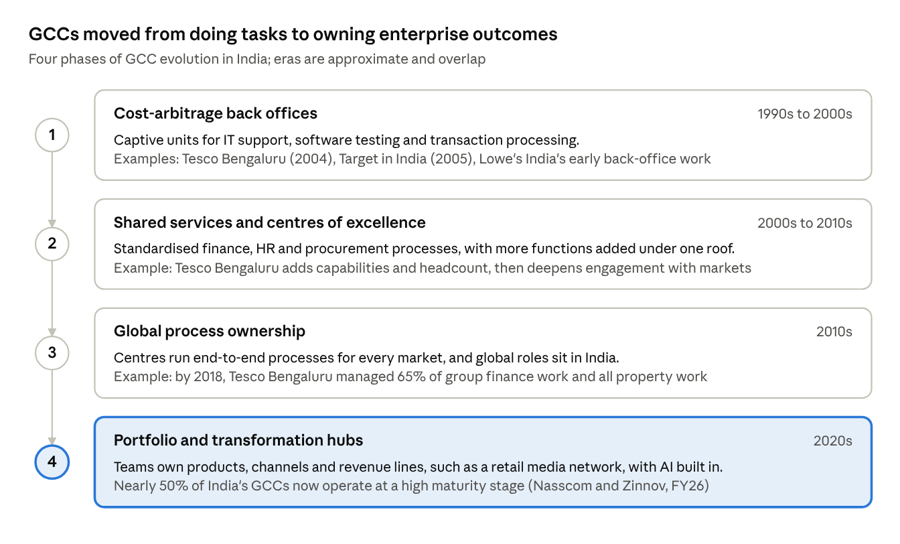
GCCs have gone through four broad phases. Each one gave the India team more say over the work, from following instructions to answering for results.
GCC evolution · four phases
At each step the real change was who decides, who is accountable, and for which markets. Marketing followed the same curve as finance and supply chain, often in the same building. It sped up once campaigns became something you run on data every day instead of a few big launches a year.
The pace keeps picking up. Nearly half of the GCCs set up since FY2021 had AI at the centre of their plans from the start, and more than 1,200 GCCs in India now have AI and machine learning built into their work.
The marketing and non-IT roles moving to GCCs
Non-tech roles in India’s GCCs are expected to reach 500,000 by 2028, and demand for them grew 17.2% year on year in the first half of 2026. Sales operations, finance and business operations make up more than 60% of that demand, and Quess expects sales and marketing hiring to keep growing.
Marketing job titles are still a small slice. Sales, marketing and customer success made up about 3% of all GCC hiring in 2026, per the foundit Insights Tracker. The bigger story sits next door. AI, data science and analytics roles took 18% of GCC hiring and grew 38% year on year, faster than any other function, and many marketing analytics roles are counted there.
What moves first is the repeatable, measurable layer of marketing: content versioning, performance creative, retail media operations, search, email, testing and measurement.
Marketing roles: where teams start and where they end up
| Role family | Typical starting scope | Mature ownership |
| Marketing operations | Campaign set-up, trafficking, QA, asset resizing | The martech stack, campaign governance and the global marketing calendar |
| Performance marketing | Bid and budget changes, product feeds, weekly reports | Spend and strategy for paid search, paid social and retail media, against return on ad spend (ROAS) targets |
| Marketing analytics and insights | Dashboards and standard reports | Attribution, media mix modelling, testing, and pricing and promotion analytics |
| CRM and loyalty | Email builds and list pulls | Lifecycle programmes, personalisation and loyalty offers |
| Content and creative production | Resizing and adapting assets | An in-house studio for product content, 3D imaging, copy and design |
| Retail media and ad tech | Campaign fulfilment for advertisers | Running and growing a retail media business |
Other non-IT functions on the same path
| Function | Typical starting scope | Mature ownership |
| Finance and accounting | Invoice processing, reconciliations | Record-to-report, planning and analysis, controllership |
| Supply chain and procurement | Purchase orders, vendor data | Demand planning, category management |
| Human resources | Payroll, onboarding admin | Global HR operations, people analytics |
| Clinical and regulatory (pharma) | Case intake, data entry | Drug safety, clinical data management, regulatory writing |
Why marketing is moving now
- Campaigns never switch off. Marketing has become a constant cycle of audience signals, search, email, social, retail media and performance creative. A team in India can work into Europe’s day and hand over to North America, which suits always-on optimization.
- Brands want their data close. A GCC puts analysts, engineers, media operators and designers on one stack with one set of approvals. That helps when you are personalizing at scale or changing campaigns daily.
- The skills have blended. About one in three business operations roles in GCCs now asks for digital platform, analytics or AI skills.
- AI is already in the budget. EY found 83% of India’s GCCs are investing in GenAI and 58% in agentic AI.
- Cost is no longer the headline. GCC roles often pay 12% to 20% more than comparable roles at IT services and non-tech firms, according to ACCA. Brands pay for talent, speed and control.
Six companies that turned India teams into owners
Each of these centres started with narrow work. Four are marketing stories. The last two show the same pattern in finance and pharma, and they are useful benchmarks for how far ownership can go.
| Company | Sector | Where it started | What it owns today |
| Lowe’s India | Home improvement retail | Back-office support | Marketing content, about 80% of floor plans and planograms, and the Lowe’s Media Network |
| Target in India | Retail | A small IT team, set up in Bengaluru | Marketing, loyalty, store design and finance; about 80% of store remodels |
| PepsiCo, Hyderabad | Consumer goods | A business services center of 250 people (2019) | Consumer and shopper insight, social media analytics and performance media execution |
| Heineken, Hyderabad | Beverages | Opened April 2026 | Digital, AI and business services, working alongside a new agency roster |
| Tesco in Bengaluru | Retail | Centralized shared services | 65% of group finance work, payroll for 320,000 colleagues and all property work (2018) |
| Novartis, Hyderabad | Pharmaceuticals | A support hub | Commercial operations, clinical operations, regulatory affairs, finance and HR |
Lowe’s India
Lowe’s Bengaluru center began with back-office support. It moved into technology and analytics, then into omnichannel product work and marketing. By Lowe’s own 2024 figures, it employs more than 4,200 people across technology, analytics, merchandising, supply chain, marketing and finance.
The marketing detail is what stands out. According to ANSR’s retail GCC study, a marketing team of more than 100 people in India handles content work such as 3D imaging, email campaigns, social media and loyalty marketing. Around 80% of floor plans and planograms are now managed from India. And the Lowe’s Media Network, launched in 2021 and now serving more than 200 clients, was conceived and built by the India team.
That last point is the one to remember. A team that started in the back office went on to build a revenue line.
Target in India
Target set up its Bengaluru centre in 2005 with GCC specialist ANSR. It started as a small team building IT capabilities for the US headquarters. Today it has about 5,700 people, and only around 40% of them work in technology. The rest cover merchandising, store design, marketing, finance and operations.
India teams design and deliver around 80% of Target’s store remodels. They also worked on Target’s revamped loyalty programme, including the interface, personalized offers and marketing. Target now hires copywriters and art directors in Bengaluru, and its campaign performance and insights roles there carry responsibility for data accuracy and market-level insight.
Target’s India president describes the center as the company’s second headquarters.
PepsiCo in Hyderabad
PepsiCo’s Hyderabad business services center opened in 2019 with 250 people and had grown past 2,800 a few years later. At the time, PepsiCo described the center’s work mainly as digitizing HR and financial services.
The marketing work came later. PepsiCo’s current Hyderabad opening includes social media analytics, consumer and shopper insight, media execution and digital commerce. One media execution role covers performance campaigns across retailer platforms and PepsiCo brands.
Brands used to hand this kind of work to a specialist agency or platform partner. Inside a GCC it sits next to commerce data and insight teams, with fewer handoffs and faster learning.
Heineken in Hyderabad
Heineken opened its Hyderabad business services center in April 2026, and its CFO tied the move to more efficient, digitally enabled ways of working. A few days later, Heineken announced a reworked global roster of creative, production and media agencies.
Put the two moves side by side and you see where most brands are heading. The GCC runs the repeatable machine: measurement, testing, content versioning and media operations. Agencies are brought in for big creative ideas and an outside view.
Tesco in Bengaluru
Tesco opened its Bengaluru center in 2004 to standardize processes and centralize capabilities. By 2018 it managed 65% of Tesco’s finance work, ran payroll for 320,000 colleagues and handled all property work across markets, from buying land to designing store layouts in 10 countries.
Its then-CEO described four stages: build the site, add capabilities, deepen ties with the markets it served, then automate and run as a global function. Tesco chose a few functions and took them over completely for every market. That approach works just as well for a marketing team.
Novartis in Hyderabad
Novartis’s Hyderabad corporate center grew over two decades from a support hub into the company’s largest corporate center worldwide. It now houses commercial operations for the US and international markets, alongside drug development, finance, HR, strategy and supply. India has more than 9,000 Novartis employees, about 11% of its global workforce.
The development hub supports clinical operations, drug safety and regulatory affairs, and as of July 2024 it listed 52 active clinical trials across 335 sites. If trial operations can run from India, the case for moving marketing analytics is an easy one to make.
How ownership grows
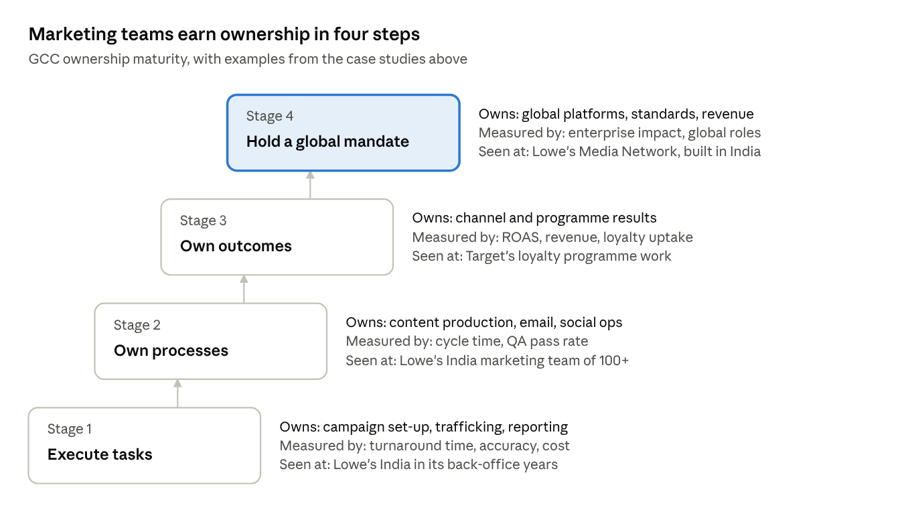
The same pattern runs through all six companies. Teams start with tasks, take over processes, then answer for results, and finally hold a global mandate. Each step is earned by doing the one before it well.
GCC ownership maturity · four stages
What moved these teams up the ladder:
- They proved the process first. Tesco automated and improved its processes before it ran them as a global function.
- Their leaders took on global roles. Many of Target’s India-based leaders now manage global teams.
- Their work showed up in business results. The Lowe’s Media Network, built in India, is a revenue line serving more than 200 clients.
- They had depth around them. Novartis first came to Hyderabad for its scientific talent and the Genome Valley ecosystem. For marketing teams, the equivalent is access to agency, platform and analytics talent.
A step-by-step plan for a marketing GCC
You don’t need twenty years to get where Lowe’s and Target are. Of the GCCs set up in India since FY2021, 96% launched with a product or portfolio mandate from day one. What matters is planning for ownership from the start.
- Pick a first team with clear numbers. Marketing ops, reporting and analytics, paid search and paid social execution, or CRM builds are good places to start. The processes are stable and you can track performance from week one. Avoid anything your headquarters is in the middle of redesigning.
- Write down what the team will own, and when. Tasks first, then processes, then channel results, then a global mandate. Put rough dates against each stage.
- Pick the model that fits that plan. A managed or GCC-as-a-Service model works well for proving a team. Build-Operate-Transfer suits you if you already know you want to own it. Agree transfer triggers, asset and lease ownership, and employee transfer terms in the first contract.
- Hire marketing leaders first. Your first hires should have run global campaigns or analytics teams. Professionals with 7–12 years of experience made up nearly 60% of non-tech GCC demand in 2025, partly for this reason.
- Hand over real decisions. Let the team change bids, budgets and audiences within agreed limits. Give the India lead a reporting line into the global marketing owner; 64% of GCC site leaders in India already combine global functional ownership with running the site.
- Measure what marketing measures. Move past turnaround time and error rates to ROAS, customer acquisition cost, incrementality and revenue influenced.
- Settle data access early. Decide which customer data the team can see, where it is stored and how consent is handled before the first campaign goes live.
- Draw the line with your agencies. Spell out what stays with them, such as big creative ideas and culturally sensitive calls, and what moves to the GCC, such as production, media operations and measurement.
- Transfer when the team is ready, not when the calendar says so. Ready means it runs its processes on its own, its leaders hold global roles and its numbers are steady. Some companies keep a managed model for good, and that’s a perfectly good outcome.
Systems Plus with us
If you want marketing ops, analytics or performance marketing capacity in India without building everything yourself, a managed GCC gets you started quickly and keeps the path to ownership open.
We have delivered 30+ GCCs with single digit attrition rates. We work as part of your team, from picking the first function to planning the handover.
